Mixed-comfort returns are a structural problem in the adjustable sleep category. One partner wants the head raised to read; the other wants flat for sleep. On a conventional single-articulation unit, every compromise is a comfort complaint waiting to become a return — and every return in this category is heavy, bulky and margin-destroying. The split-back electric mattress exists to eliminate that conflict: two sleepers, one mattress, independently set head inclines. This article gives buyers an engineering-level evaluation of the KCAI KD002-B1 (2000x1800x280mm) — how the split-back architecture works, what the dual-motor system demands from a manufacturer, and why the honeycomb aluminum panel matters structurally.
The Split-Back Concept: Independent Head Inclines for Two Sleepers
A split-back electric mattress divides the backrest into left and right sections, each with its own articulation drive. One sleeper can raise the head section to 0–55° for reading or television while the partner stays flat — on a single 2000x1800x280mm unit, with no center gap and no second remote to lose. The leg section articulates independently at 0–35° as a unified unit.
Buyers should understand precisely what "split" covers, because terminology varies across the market. On the KD002-B1, the split architecture applies to the backrest: left and right head sections lift independently. The leg section is an independent articulation zone but is not split left/right. When benchmarking competing "split" products, demand a motion diagram from each supplier and confirm which zones split, which zones move together, and whether independent operation requires synchronized or separate controls. A supplier that cannot produce that diagram has not engineered the product — it has named it.
Compared with a single-articulation unit, split back roughly doubles the mechanism's drive complexity. That complexity is the product's value proposition and its quality risk in equal measure, which is why the motor architecture and structural platform sections below deserve a buyer's full attention. Evaluate split-back offers against our engineering evaluation framework with particular weight on mechanism transparency.

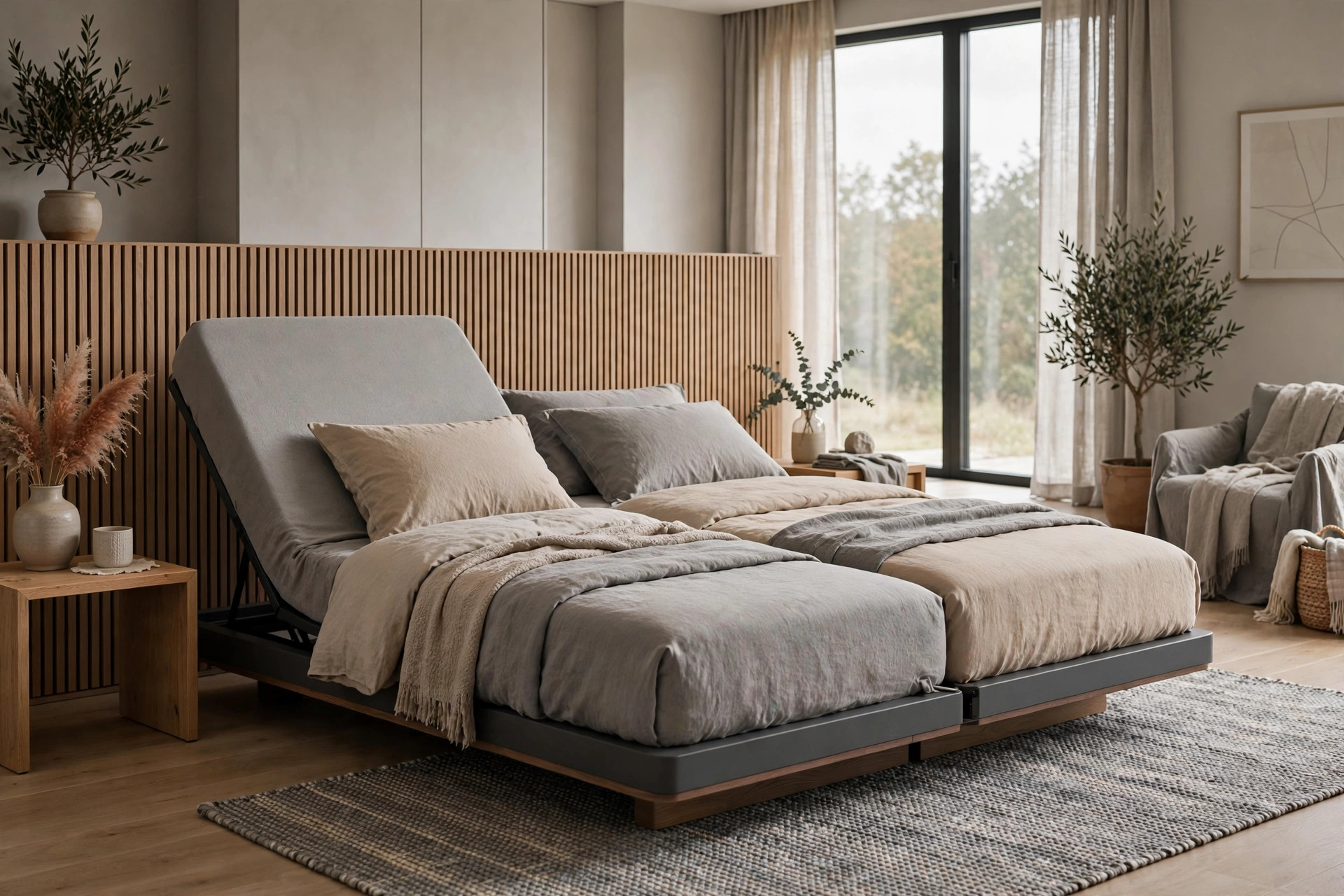
Scenario illustration — lifestyle context shown for inspiration only; not a photograph of the actual KD002-B1 product.
Why Split Back Sells: Couples, Senior Living and Hospitality Programs
Three buyer segments drive split-back demand, and each has distinct engineering requirements.
Couples' retail programs. The pitch is conflict resolution: independent head inclines end the nightly negotiation. For retailers, this converts directly into attachment value — split back is a premium story that justifies premium positioning, and the demonstration (one side up, one side flat) sells itself on the showroom floor. Buyer checkpoint: confirm that both sides reach the full 0–55° independently and return to flat without drift between sides over repeated cycles.
Senior-living and home-care shared rooms. Partners or roommates sharing adjustable sleep surfaces often have different elevation needs — one may prefer a raised head position for reading comfort while the other prefers flat. Independent articulation serves both without compromise. Positioning note for buyers: describe this as lifestyle ergonomics and comfort positioning. An electric mattress is not a medical or hospital bed, and comfort features should never be presented as treatments — customers with sleep apnea or serious conditions should consult a doctor or sleep specialist.
Hospitality and project programs. Hotels and serviced residences use split back to widen the room's appeal: the same unit serves a reader and a flat-sleeper, a back-sleeper and a side-sleeper. For project buyers, the procurement logic is standardization — one SKU covering more guest profiles means fewer SKUs to manage across properties. Buyer checkpoint: confirm control simplicity (guests must operate it without instruction) and one-key reset to flat for housekeeping turnover.
KD002-B1 Verified Specifications: The Transparency Table
Every figure below is confirmed from KCAI engineering documentation. Parameters not confirmed at model level are marked "request the official spec sheet" and are not stated here. Use the left column to interrogate competing offers.
| Parameter | KD002-B1 (verified) | Low-spec market risk |
|---|---|---|
| Unit dimensions | 2000 × 1800 × 280 mm | Non-standard footprints that complicate bed-frame pairing and project fit-outs |
| Backrest articulation | 0–55°, left/right independent split | Single articulation marketed as "split"; one partner's setting drags the other |
| Leg articulation | 0–35°, independent unit | Fixed leg sections that limit comfort positioning programs |
| Articulation platform | Honeycomb aluminum panel | Board-only or thin-steel platforms that flex, creak and fatigue at hinge points |
| Motor platforms | OKIN / Haojiang | Unbranded actuators with no traceable duty rating; asymmetric wear between sides |
| Cycle validation | Cycle durability testing program | No documented test protocol; split mechanisms fail asymmetrically under uneven use |
| Lab testing | CNAS · SGS · TUV · UL lab-tested | Compliance claims with no third-party lab report on file |
| Factory footprint | Since 2004 · 25,000 sqm · 100+ global customers | No verifiable manufacturing depth for a mechanically complex product |
Dual-Motor Architecture: What Buyers Should Verify
Split back means two independent backrest drives operating in one chassis. This is where engineering separates from marketing. Four buyer checks matter:
1. Independent duty ratings. Each side's drive must be rated for its own full duty cycle, not for half of a shared rating. Ask for the motor platform (KCAI specifies OKIN / Haojiang), the rated duty behavior, and whether the control system prevents both sides from drawing peak current simultaneously in a way that would brown out the power supply. A named motor platform with traceable specifications is the minimum acceptable evidence.
2. Synchronization and anti-drift. Over hundreds of cycles, independent drives can drift — one side returning to 54° while the other reaches 55°, or one side settling slightly off flat. Quality split-back programs include position feedback or calibrated endpoints. Ask the supplier how end-of-travel is defined per side and what tolerance is held between sides after extended cycling. If the answer is "the remote handles it," the question has not been answered.
3. Failure isolation. When one side's drive faults, does the other side keep working? In couples' use, a single-side failure that disables the whole unit doubles the complaint. Request the failure-mode behavior in writing: independent operation must degrade gracefully, not fail jointly.
4. Control architecture. Independent articulation needs a control scheme a retail customer can operate without training — clearly separated left/right controls, plus one-key reset to flat. Across the electric mattress series, control options include wired and wireless remotes, the Sleepace sleep system, APP and mini-program control, voice control with Siri support, and smart-home platform access (Huawei, Xiaomi, Alibaba, Tuya, Amazon IoT). Confirm the exact control configuration for the KD002-B1 program against the official spec sheet, and validate it with real users before committing to volume — the most common field complaint in this category is not mechanism failure but control confusion.
Honeycomb Aluminum Panel: Structural Engineering Explained
The honeycomb aluminum panel is the KD002-B1's structural signature, and it deserves more than a bullet point. In an articulating mattress, the panel beneath the comfort layers is the load path: every hinge force, every motor thrust, every kilogram of sleeper weight transfers through it thousands of times over the product's service life.
Honeycomb construction — two face sheets bonded to a cellular core — delivers high bending stiffness per unit weight, which matters in three specific ways. First, it resists the flex that causes creaking and fastener loosening at hinge points; a panel that flexes works its own screws loose over time. Second, it distributes concentrated hinge loads across a wider area, reducing stress peaks that initiate fatigue cracks in lesser platforms. Third, its dimensional stability keeps left and right articulation geometry aligned — critical in a split-back unit where the two sides must track independently without binding at the center seam.
The procurement comparison is straightforward: board-only or thin-steel platforms are cheaper and heavier, and they transmit every hinge stress directly to fasteners. When a competing supplier offers a split-back unit at a lower price, the panel is one of the first places the cost was removed. Ask what the articulation platform is made of, how hinge loads are distributed, and what the fatigue validation covers. If those answers are vague, the price advantage is a warranty liability in disguise.
Quality, Compliance and Cycle Testing
Split-back mechanisms fail asymmetrically — one side sees more cycles than the other in real couples' use, and the center seam sees shear that single-articulation units never experience. This makes documented cycle durability testing more important for split back than for conventional units, not less. KCAI validates the lifting mechanism through a cycle durability testing program; buyers should request the test report and examine the load conditions, dwell times at travel extremes, inspection checkpoints and pass criteria — the same four audit points described in our engineering evaluation framework.
A deliberate note on figures: this article does not quote a cycle count for the KD002-B1. Cycle figures without their test conditions are not comparable between suppliers, and a number quoted without a report is a marketing figure. What matters is the documented protocol behind the claim. Request the report, compare its conditions against your own requirements, and disqualify any supplier that cannot produce one.
On compliance: electrical articulation products crossing borders need verified laboratory evidence, not brochure logos. The KCAI program is CNAS · SGS · TUV · UL lab-tested. Request model-level test reports, confirm the tested scope against your destination market's requirements, and treat industry reference standard numbers cited by third parties as general benchmarks — never as a supplier's certified scope. Verify scope, model coverage and validity dates directly against KCAI's official documentation.
Two Paths to Market: OEM/ODM Customization and Wholesale Supply
KCAI Intelligent Sleep has manufactured adjustable sleep systems since 2004 from a 25,000 sqm facility serving 100+ global customers — the manufacturing depth that makes a mechanically complex product like split back viable at volume.
Path 1 — OEM/ODM customization. For brands building differentiated assortments, the KD002-B1 platform supports OEM/ODM programs: split-zone configuration, comfort-stack tuning, fabric and quilting programs, control interfaces and function options can be developed to your specification. Because the dual-drive mechanism, electronics and upholstery are engineered in-house, customization does not require re-qualifying a third-party mechanism supplier. Prepare your inquiry with target segments (couples' retail, senior living, hospitality), configuration requirements and packaging constraints, and contact us to request the official spec sheet and an RFQ template so engineering and costing start from documented figures.
Path 2 — wholesale of the existing model. For distributors and retail programs that need a proven split-back SKU quickly, the KD002-B1 is available as factory-direct wholesale supply in its existing configuration. This is the container-optimized route: one documented SKU, verified 0–55°/0–35° articulation, honeycomb aluminum structural platform, and a cycle durability program your quality team can audit. Either way, begin from the OEM/ODM program page or request a quote — and bring the transparency table from this article to every supplier conversation you have.
FAQ
What is a split back electric mattress? The backrest is divided into left and right sections that articulate independently, so two sleepers sharing one mattress set their own head incline. The KCAI KD002-B1 implements this at 2000x1800x280mm with 0–55° backrest and 0–35° leg articulation.
Does the leg section split as well on the KD002-B1? No. The KD002-B1's split architecture applies to the backrest (left/right independent lift); the leg section articulates as one independent unit at 0–35°. Confirm the exact motion program against the official spec sheet.
What does the honeycomb aluminum panel do structurally? It forms a rigid, dimensionally stable articulation platform that distributes hinge loads across the mechanism, reducing flex, noise and fastener fatigue compared with low-grade steel or board-only constructions.
What cycle testing backs the KD002-B1? The program is validated through cycle durability testing of the lifting mechanism. Buyers should request the test report — including load, dwell and pass criteria — rather than relying on any cycle figure quoted without documentation.
Can I buy the KD002-B1 as OEM/ODM or as wholesale of the existing model? Both. KCAI supports OEM/ODM customization programs as well as wholesale supply of the existing KD002-B1 model. Contact us to request the official spec sheet and an RFQ template for either path.