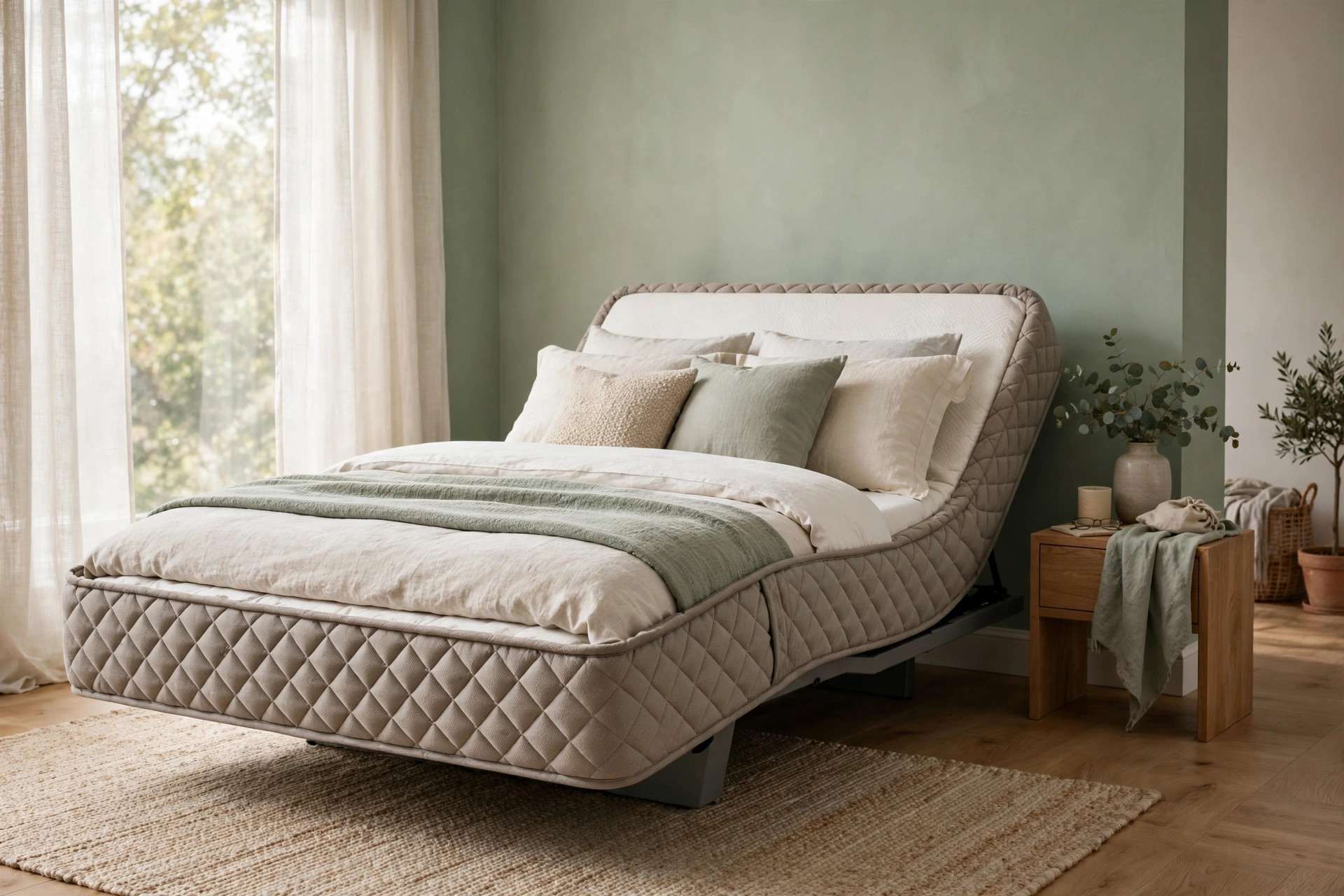
Warranty return rates are the quiet profit killer in the adjustable sleep category. A procurement team sources what looks like a cost-effective electric mattress, ships a container, and six months later the service tickets arrive: mechanisms that jam mid-articulation, remotes that lose pairing, head sections that sag below their rated angle. Each return erodes margin twice — once in logistics, once in brand trust. This article gives buyers an engineering-level evaluation of the KCAI KD001-B2 electric adjustable mattress (2000x1800x530mm), including how to read its 15,000+ cycle aging test record and how integrated-lift architecture compares with separate base-plus-mattress programs.
What "Integrated-Lift Mattress" Means — and Why It Changes Your Category Strategy
Most adjustable sleep products split the job: an adjustable base program provides the articulation, and a passive mattress sits on top. An integrated-lift electric mattress collapses both roles into one unit. The lifting mechanism — motors, hinge linkages, articulation panels — is built into the mattress body itself, so the backrest 0–55° and leg rest 0–35° ranges are delivered by the mattress, not by a frame underneath it.
This has three direct procurement consequences. First, SKU consolidation: one unit replaces a two-part combination, which simplifies container planning and reduces the mismatch returns that occur when a retailer's mattress and base come from different suppliers with different articulation geometry. Second, showroom simplicity: the product demonstrates itself; there is no hidden hardware story to explain. Third, engineering accountability: articulation accuracy, cycle durability and motor performance are all owned by a single manufacturer, which makes root-cause analysis on warranty claims dramatically simpler than multi-vendor fault tracing.
The tradeoff is category fit. An integrated mattress is heavier and thicker than a passive mattress, and it cannot be swapped onto an existing base the way a passive mattress can. Buyers targeting replacement-mattress assortments should stay with conventional ranges; buyers building flagship adjustable sleep stories — where the mattress is the hero — should evaluate integrated-lift units against our engineering evaluation framework.
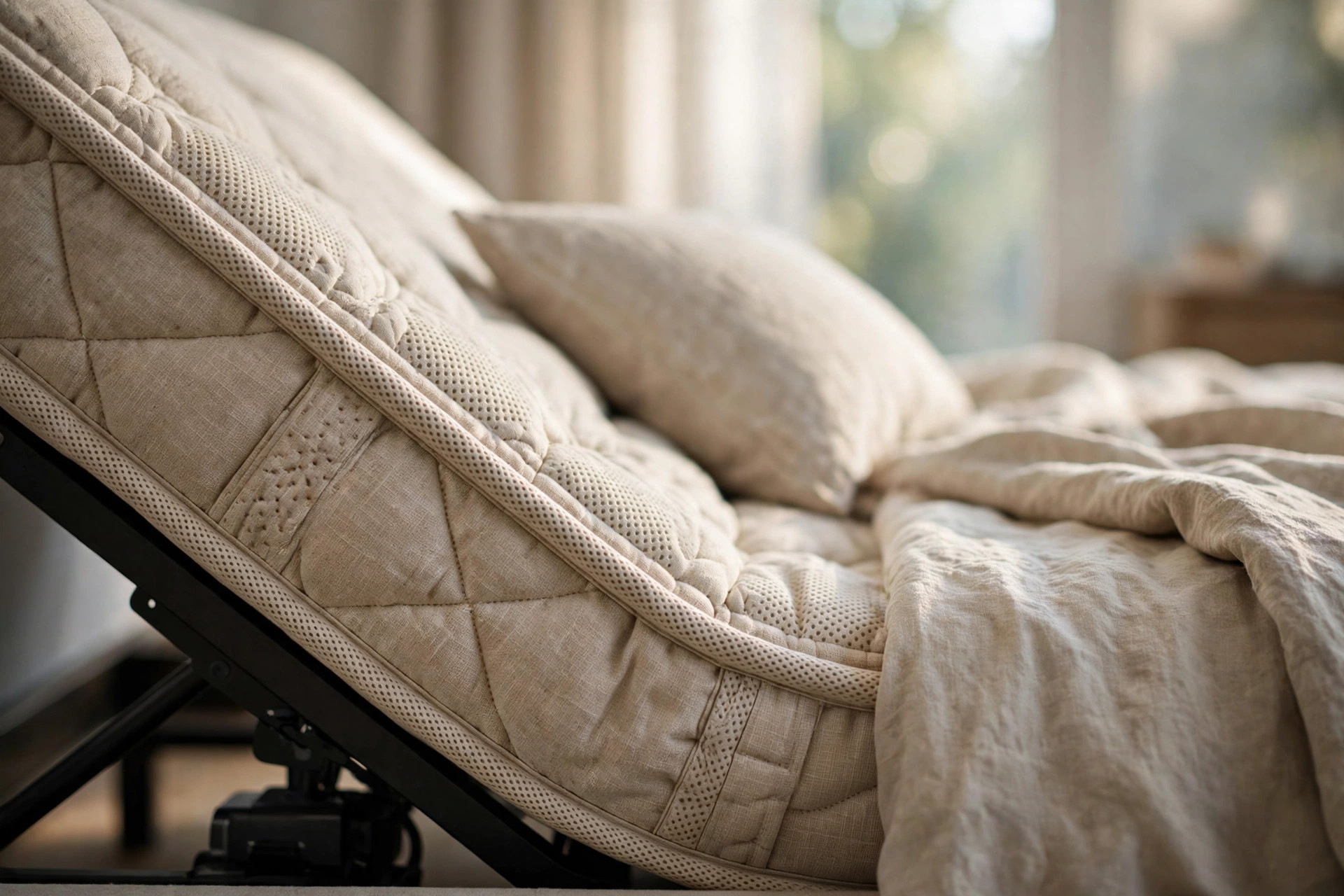
Scenario illustration — lifestyle context shown for inspiration only; not a photograph of the actual KD001-B2 product.
Electric Mattress or Adjustable Base? A Buyer's Decision Framework
The most common sourcing question we hear is whether to range an integrated electric mattress or an adjustable base with passive mattresses. The engineering answer depends on your program architecture:
- Choose an integrated electric mattress when you want a single-SKU flagship, when your retail floor needs a self-demonstrating hero product, when you want one manufacturer accountable for the full articulation system, and when your customers value preset programs (deep sleep, zero-gravity, reading, cinema) delivered out of the box.
- Choose an adjustable base plus passive mattress when you run broad mattress assortments that must stay base-agnostic, when customers already own bases, when you need per-width scaling (the KCAI adjustable base series spans 2000x900mm up to 2000x1800mm configurations), or when your logistics favor lighter, separable units.
A frequent middle path is a split program: integrated-lift mattresses as the premium hero SKU and adjustable bases covering the volume mid-range. If you are weighing the two, evaluate both against our engineering evaluation framework rather than against marketing sheets — the framework scores mechanism transparency, test evidence and motor platform consistency, which is where low-spec suppliers typically fail.
KD001-B2 Verified Specifications: The Transparency Table
Every figure below is confirmed from KCAI engineering documentation. Parameters marked "request the official spec sheet" were not confirmed at model level and are not stated here. Use this table to benchmark competing offers — any supplier unable to fill the left column with documented figures is a warranty risk.
| Parameter | KD001-B2 (verified) | Low-spec market risk |
|---|---|---|
| Unit dimensions | 2000 × 1800 × 530 mm | Undersized units that mismatch standard bed frames and drive fit-related returns |
| Backrest articulation | 0–55° | Mechanisms that lose angle range after months of cyclic loading |
| Leg rest articulation | 0–35° | Coarse preset positions with no fine comfort adjustment |
| Lifting-system durability | 15,000+ cycle aging tests | No documented test protocol; hinge and linkage failures drive warranty returns |
| Motor platforms | OKIN / Haojiang | Unbranded actuators with inconsistent torque, noisy operation, no traceability |
| Comfort stack | Knitted fabric quilted, natural latex, high-density foam, independent pocket springs, 3D breathable material | Thin foam-only stacks that bottom out; poor airflow causing heat complaints |
| Preset modes | Deep sleep / zero-gravity / memory (one-key reset) / anti-snore / vibration massage / reading / cinema | Two-button remotes with no programmed positions |
| Lab testing | CNAS · SGS · TUV · UL lab-tested | Compliance claims with no third-party lab report on file |
| Factory footprint | Since 2004 · 25,000 sqm · 100+ global customers | No verifiable manufacturing footprint or capacity evidence |
The 15,000-Cycle Test: A Durability Story Buyers Can Audit
"15,000+ cycle aging tests" is the single most quoted figure on the KD001-B2 — and the most frequently misread. It is not a lifespan promise. It is a laboratory durability protocol, and its value to a buyer depends entirely on the test conditions behind the number. Here is how to read it the way a quality engineer would.
A cycle aging test for an integrated-lift mattress typically runs the articulation through full backrest travel (0–55°) and full leg travel (0–35°) under a rated, distributed load, with programmed dwell times at the extremes — the points of maximum hinge and linkage stress. Instrumentation tracks motor current draw drift (rising current signals increasing mechanical resistance), checks hinge welds and fasteners for cracking, and verifies that angle accuracy stays within tolerance across the full run. Electronics — remotes, control boxes, wiring harnesses — are cycled alongside the mechanism because field failures are frequently electrical, not mechanical.
When a supplier quotes a cycle count, request the test report and check four items: the applied load and its distribution, the dwell time at travel extremes, the inspection checkpoints and pass/fail criteria, and whether the report comes from a lab with recognized accreditation. A 15,000-cycle record from a CNAS · SGS · TUV · UL lab-tested program, with documented conditions, is auditable evidence. A bare number with no report is a marketing figure. The KCAI program is built around the auditable kind — ask for the report, compare its conditions against your own accelerated-life requirements, and benchmark competitors on the same four points. Suppliers who cannot produce a report forfeit the durability argument entirely.
Preset Modes, Motors and the Comfort Stack Buyers Should Evaluate
The KD001-B2 ships with seven programmed modes: deep sleep, zero-gravity, memory (one-key reset), anti-snore, vibration massage, reading and cinema. For buyers, modes are more than features — they are return-prevention tools. One-key reset, for example, eliminates the support calls that come from users who cannot return a bed to flat; anti-snore provides a comfort-positioning head incline that may help some users rest more comfortably (it is a positioning feature, not a treatment — buyers should advise customers with sleep apnea or serious sleep conditions to consult a doctor or sleep specialist).
The drive side uses OKIN and Haojiang motor platforms, specified for gradual rise-and-fall motion, low-noise operation and energy-saving drive characteristics. These are established actuator platforms with traceable supply chains — a meaningful contrast with unbranded mechanisms whose torque curves and duty ratings cannot be verified. Evaluate any competing offer on the same basis: named motor platform, stated duty behavior, and documented noise characteristics. If those are absent, the offer is unpriceable on total cost of ownership.
The comfort stack — knitted fabric quilting, natural latex, high-density foam, independent pocket springs and 3D breathable material — addresses the two most common comfort complaints in adjustable mattresses: bottoming out under articulation stress and heat buildup. Note the construction logic: pocket springs and high-density foam carry the mechanical load of repeated articulation, while latex and 3D breathable material manage surface comfort and airflow. Control options across the electric mattress series include wired and wireless remotes, the Sleepace sleep system, APP and mini-program control, voice control with Siri support, and smart-home platform access (Huawei, Xiaomi, Alibaba, Tuya, Amazon IoT). Function options include low-frequency vibration massage, USB charging ports, LED lighting, sleep monitoring, intelligent anti-snore positioning and timed wake-up. Confirm the exact control and function configuration for your program against the official spec sheet — not every function ships in every configuration.
Compliance and Lab Testing: CNAS · SGS · TUV · UL in Practice
Electrical products that articulate, vibrate and connect to mains power cross multiple compliance regimes, and customs holds on non-compliant sleep electronics are an expensive education. The KCAI testing program runs through CNAS · SGS · TUV · UL lab testing — recognized third-party laboratory channels that buyers can verify.
The practical buyer move is documentation discipline: request the actual test reports by model, confirm which standards and clauses were tested (rather than accepting a logo on a brochure), and align the reports with your destination market's requirements before the first container ships. Industry reference standards exist for flammability, electrical safety and EMC in this category — but specific standard numbers cited by third parties describe general industry benchmarks, not KCAI's certified scope. Do not let any supplier present an industry reference number as its own certification; always request KCAI's official test documentation and verify scope, model coverage and validity dates directly.
Two Paths to Market: OEM/ODM Customization and Wholesale Supply
KCAI Intelligent Sleep has manufactured adjustable sleep systems since 2004 from a 25,000 sqm facility serving 100+ global customers — the manufacturing depth behind both commercial paths below.
Path 1 — OEM/ODM customization. For brands building proprietary assortments, the KD001-B2 platform supports OEM/ODM programs: comfort-stack tuning, fabric and quilting programs, control interfaces and function configurations can be developed to your specification. Because the lifting mechanism, electronics and upholstery are engineered in-house, customization does not require re-qualifying a third-party mechanism supplier — the factory that builds the unit also builds the articulation system inside it. Prepare your inquiry with target markets, configuration requirements and packaging constraints, and contact us to request the official spec sheet and an RFQ template so engineering and costing start from documented figures.
Path 2 — wholesale of the existing model. For distributors and retail programs that need a proven SKU quickly, the KD001-B2 is available as factory-direct wholesale supply in its existing configuration. This is the container-optimized route: a single documented SKU, verified specifications, and a 15,000+ cycle test record you can put in front of your own quality team. Either way, begin from the OEM/ODM program page or request a quote — and bring the transparency table from this article to every supplier conversation you have.
FAQ
What is an integrated-lift electric mattress? The lifting mechanism is built into the mattress unit itself, so it articulates without requiring a separate adjustable base. The KD001-B2 uses this integrated architecture at 2000x1800x530mm with backrest 0–55° and leg rest 0–35°.
Is 15,000+ cycle aging testing a lifespan promise? No. It is a lab durability protocol covering repeated full articulation under rated load. Treat the number as a test record, not a service-life guarantee, and request the test report with its load, dwell and pass criteria before benchmarking suppliers.
What are the verified dimensions and articulation angles of the KD001-B2? 2000x1800x530mm, backrest 0–55° and leg rest 0–35°. These are the confirmed specification figures; anything beyond them should be confirmed against the official spec sheet.
Which motors drive the KD001-B2 lifting system? The electric mattress series is engineered around OKIN and Haojiang motor platforms, characterized by gradual rise-and-fall motion, low-noise operation and energy-saving drive characteristics.
Can I buy the KD001-B2 as OEM/ODM or as wholesale of the existing model? Both. KCAI supports OEM/ODM customization programs as well as wholesale supply of the existing KD001-B2 model. Contact us to request the official spec sheet and an RFQ template for either path.