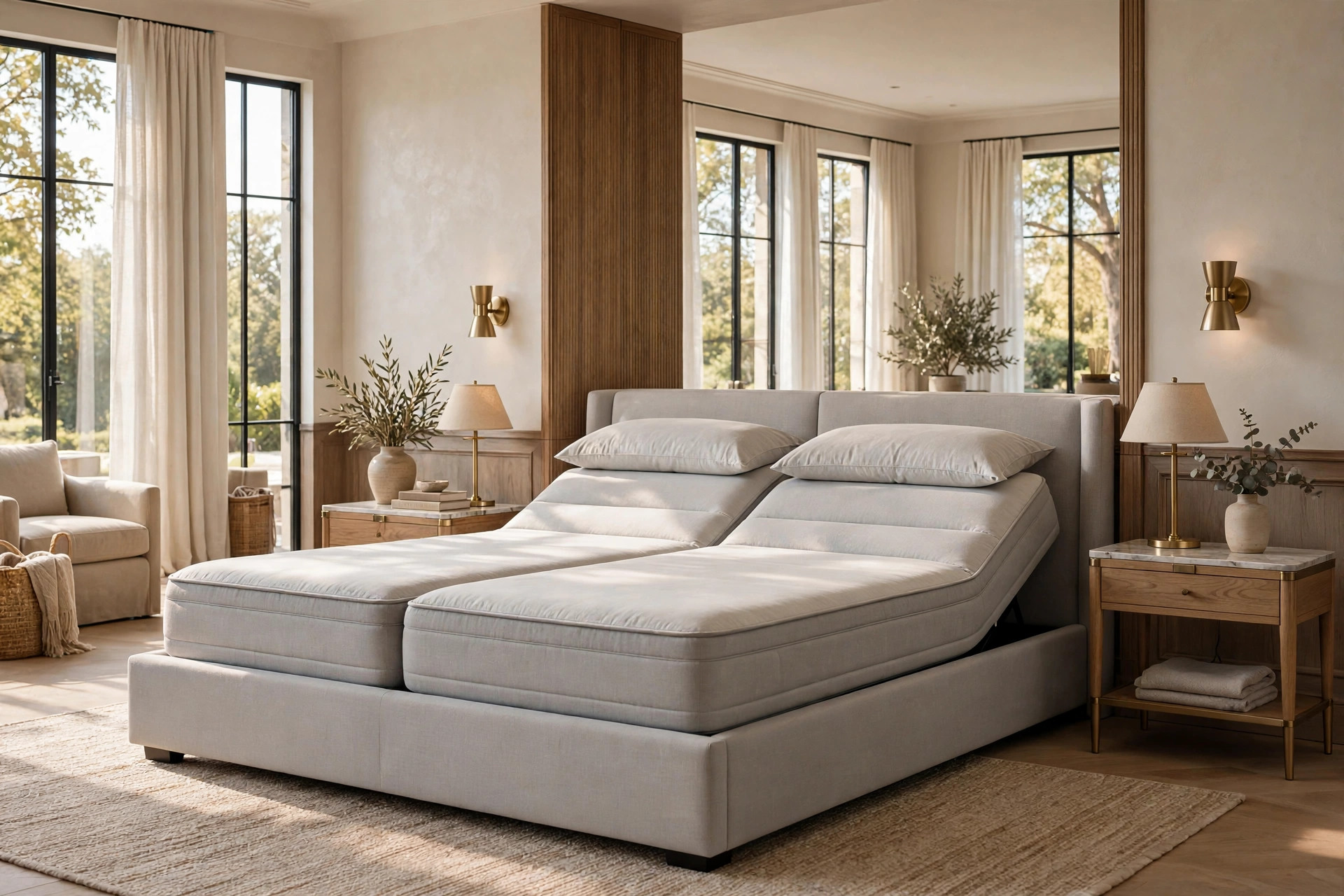
Cover image: an AI-generated lifestyle scene for illustration (not an actual product photo).
A container arrives at a distributor's warehouse in Europe. Two pallets of lifting bases, two pallets of mattresses — and nothing pairs. The base mounting points miss the mattress interface by a few millimetres because the two components came from two suppliers working to two tolerance standards. The distributor returns forty sets, and the brand absorbs the rework cost and the damaged retail relationship. This is the hidden cost of the separated architecture: a base and a mattress that were never engineered as one system.
The alternative is integration. The KD001-B1 is a one-piece integrated electric mattress — the lifting system and the mattress built as a single unit, 2000x1800x500mm, with backrest adjustment of 0–55° and leg rest adjustment of 0–35°. One SKU to stock, one QC flow, one unboxing.
This article gives procurement engineers and category buyers a decision framework for the architecture question that should come before any price discussion: integrated versus separated. It walks through the one-piece anatomy, a verified spec table, the motor and control platform, container math, QC checkpoints, and channel fit — so you can decide which architecture serves your market before you request the official spec sheet.
The Architecture Decision: Integrated vs Separated
Every adjustable-bed sourcing program faces this choice first, and getting it wrong is expensive. In a separated architecture, the lifting system and the mattress are two independent products: a base engineered by one team, a mattress engineered by another, paired at the warehouse or at the point of retail. KCAI's KD010-A2 is a real example of this architecture — a 2000x900mm lifting base, separated from the mattress, configurable to Twin, Full, Double, Queen, or King footprints depending on the mattress the channel pairs with it. The separated model gives retailers maximum flexibility: any compatible mattress can sit on the base, and either component can be serviced independently.
In an integrated architecture, the pairing decision disappears because there is no pairing. The KD001-B1's lifting system is integrated with the mattress in a one-piece design: the drive mechanism, the articulation structure, and the sleep surface leave the factory as a single finished unit. The engineering trade-off is direct. Integrated removes the tolerance risk between two independently sourced components — no mounting-point mismatch, no retailer confusion over which mattress fits which base, no split warranty claims across two suppliers. Separated keeps component-level flexibility — a retailer can upgrade the mattress tier without touching the base, and a service technician can swap one part without replacing the whole assembly.
For a buyer, the decision logic is therefore channel-driven, not spec-driven. If your channel sells a bundled sleep product under one product code — a hotel fit-out, a bundled retail SKU, an export distributor's catalogue line — integration removes an entire class of failure. If your channel is a mattress-led retailer with a deep private-label assortment, separated keeps the mix-and-match option open. Choose the architecture that matches your business model, then evaluate the product. KCAI maintains both architectures because the right answer depends on how you sell.
One-Piece Anatomy: What 2000×1800×500mm Means
The KD001-B1's envelope is 2000x1800x500mm — a king-size footprint with a substantial, mattress-like presence. The 300mm side height is worth noting: this is not a thin base with a mattress dropped on top, but a deep-bodied unit that reads as premium sleep furniture in a showroom or a hotel room. For buyers planning bedding assortments, the king-size footprint anchors the product to standard king bedding SKUs, which simplifies the retailer's accessory story.
Inside the one-piece construction, KCAI offers multiple mattress build options to suit different positioning tiers. Confirmed construction options include knitted fabric three-in-one quilting, natural latex, high-density foam, independent pocket springs, 3D breathable material, and — on some models — graphene elastic cotton. Because the two are developed together, the articulation geometry and comfort layers are calibrated as a pair: backrest 0–55° and leg rest 0–35° against a mattress stack designed to flex through those ranges without binding at the hinge lines. That calibration is the engineering core of the integrated concept, and it is the detail a buyer should probe in any supplier's sample review: flex the unit through its full range and watch how the comfort layers behave at maximum backrest elevation.
The one-piece format also changes the unboxing experience, which matters for channels that ship direct or install in guest rooms. There is no assembly step between base and mattress and no risk that an installer mounts the wrong mattress on the wrong base. What leaves the factory is what the customer sleeps on.
Spec Table: Confirmed Parameters vs Market Risks
Procurement engineers should evaluate one-piece electric mattresses against verified parameters, not brochure claims. The table below lists what is confirmed for the KD001-B1 against the risks commonly found in low-spec market alternatives.
| Parameter | KD001-B1 (confirmed) | Common low-spec market risk |
|---|---|---|
| Footprint | 2000x1800mm, king-size | Non-standard footprints that do not fit standard bedding SKUs |
| Total height / side height | 500mm / 300mm | Thin one-piece bodies that read as underbuilt in showrooms |
| Backrest adjustment | 0–55° | Unspecified adjustment ranges |
| Leg rest adjustment | 0–35° | Unspecified adjustment ranges |
| Motors | German OKIN and Haojiang | Unspecified motor brand, no duty-cycle disclosure |
| Lifting system endurance | Validated through 10,000+ aging cycles | No cycle-test data provided |
| Controls | Wired/wireless remote, Sleepace system, APP/mini-program, voice control, Siri | Single wired remote only |
| One-piece seam construction | Request the official spec sheet | Weak seam construction at articulation hinge lines |
| Carton dims / units per container | Request exact carton specs | Quoted load counts with no carton data to verify |
Two cautions on reading this table. First, any parameter marked "request the official spec sheet" is genuinely open — do not accept a verbal figure from any supplier without the written spec. Second, treat industry benchmark figures you encounter in competitor teardowns (thrust ratings, noise levels, wall thicknesses, coating microns, container load counts, or specific standard numbers) as industry reference only. They are not KCAI specifications unless KCAI's official documentation says so. For compliance planning in your target market, always request KCAI's official certificates list rather than assuming a standard number applies.
Motor and Control Platform: The OKIN/Haojiang Drive Stack
The motor platform is the highest-failure-cost subsystem in any electric mattress, so it deserves its own evaluation pass. The KD001-B1 uses German OKIN and Haojiang motors, specified for powerful drive performance with soft start/stop behaviour, low noise, and energy saving. Soft start/stop matters: abrupt articulation stresses the hinge structure and mattress seams on every cycle, so controlled ramp-up and ramp-down directly extends the mechanical life of the one-piece assembly. A dedicated engineering guide on actuator evaluation covers the failure modes and testing logic behind these requirements in detail (see the adjustable bed actuator engineering buyer's guide).
Endurance is verified, not claimed: KCAI's lifting systems are validated through 10,000+ aging cycles. When you evaluate a supplier, ask for the cycle-test protocol behind the number — the load profile, the articulation range used during testing, and the failure criteria. A cycle count without a protocol is marketing; a cycle count with a documented protocol is engineering evidence.
The control layer is built for multi-channel compatibility. Confirmed control options include wired and wireless remotes (remote families such as SK.29.11 and SK.34.09), the Sleepace system, APP and mini-program control, voice control, and Siri integration. One-key preset modes cover deep sleep, zero-gravity, memory with one-key reset, anti-snore, vibration massage, reading, and movie positions. For hospitality buyers, the wireless and app-based control options matter because they integrate with room-level guest experience setups; for export distributors, the breadth of control options means one hardware platform can serve markets with different interface expectations, with configuration handled at firmware or accessory level. Availability of specific remote models and control features by market should be confirmed — request the official spec sheet.
Container Math: The 1.8 m³ Method
One-piece units change container economics, and the arithmetic should be worked as a method, not taken as a quoted number. Start with the footprint volume as a planning baseline:
Footprint volume = 2.000 m × 1.800 m × 0.500 m = 1.8 m³ per unit.
This is a method example — the geometric envelope of one KD001-B1. A 40HQ container offers roughly 76 m³ of internal volume (industry reference, not a KCAI specification). Dividing 76 by 1.8 gives approximately 42 units as a pure-geometric ceiling. That figure is illustrative only: real loading is governed by the actual carton dimensions, protective dunnage, stacking orientation, and the 500mm unit height interacting with the container door height. Never plan a shipment against the geometric ceiling; use it to sense-check a supplier's quoted load count, and always request exact carton specs for the real number.
The one-piece format carries a genuine logistics advantage for planning: a single SKU per shipment means a container holds one product code, one carton type, and one QC standard. Compare that with a separated program, where a container mixes bases and mattresses in a ratio that must match downstream demand — a 10% forecasting error on either side leaves orphaned inventory. For distributors running container-direct programs, the integrated architecture collapses two forecasting problems into one. If you want a worked loading plan for your target container type, contact us to request our CBM calculator — we will prepare it for your project rather than promising a download.
QC Checkpoints: One SKU, One QC Flow
The operational case for integration is sharpest in quality control. A one-piece unit moves through a single QC flow at a single factory: motor inspection, articulation calibration, seam and upholstery inspection, full-range function test, and final packaging check happen in one sequence, under one quality system. KCAI backs its manufacturing with lab testing associated with CNAS, SGS, TUV, and UL, roughly 30 years of furniture R&D heritage, multiple invention and utility model patents, and a 25,000 sqm production base with 100+ staff serving 100+ global customers since 2004.
A buyer's incoming QC checklist for a one-piece electric mattress should include: (1) full-range articulation test — run backrest and leg rest through 0–55°/0–35° and inspect seam behaviour at the hinge lines at maximum elevation; (2) motor consistency — verify soft start/stop behaviour across a sample batch; (3) control pairing — test every shipped remote and app-control path, not just the wired remote; (4) dimensional verification — confirm the 2000x1800x500mm envelope and 300mm side height against the spec sheet; (5) packaging drop and vibration check on the actual export carton.
The honest trade-off sits on the service side. A separated architecture lets a retailer replace a failed base or upgrade a mattress independently; a one-piece unit is serviced as a whole assembly. Buyers should therefore align on spare-parts and service policy before ordering: which components are field-replaceable, what the service response process looks like, and how warranty claims are documented. Request the official service and spare-parts documentation alongside the spec sheet — these terms are configurable by program, and the right answer depends on your channel's service capability. For factory capability assessment, contact us to request our factory-audit checklist.
Channel Fit: Where Integrated Wins
Architecture decisions should be tested against channels. Three channel types suit the integrated one-piece format strongly.
Hospitality projects. Hotels and serviced apartments install identical rooms at scale and value uniformity above all. One product code per room, one installation procedure, one service standard across the property — and no on-site pairing step for contractors to get wrong, which shortens fit-out schedules and reduces snagging lists.
Bundled retail. Retailers that sell sleep as a bundled product code — one SKU on the ticket, one price, one delivery — benefit from the same simplification. The retailer's staff never needs to explain base-mattress compatibility, and the customer never faces a two-box delivery where one box arrives damaged and the other is fine.
Export distributors seeking simplicity. Distributors with lean technical teams prefer programs with fewer moving parts: one SKU to forecast, one QC flow to manage, one set of compliance documents per shipment.
Where integration is weaker: mattress-led retailers with deep private-label assortments who need to pair multiple mattress tiers with one base platform. For those channels, the separated architecture — KCAI's KD010-A2 approach — remains the better fit. A capable supplier offers both architectures and helps you match the product to the channel; if a factory pushes only one architecture regardless of your business model, treat that as a signal about their range, not about the market.
On positioning, the KD001-B1 sits in lifestyle ergonomics: posture alignment, adjustable comfort positions, and an anti-snore head incline that may help with snoring comfort. These are comfort and lifestyle claims, not medical ones — adjustable positioning is not a substitute for medical treatment, and buyers addressing customers with serious conditions should advise consulting a doctor. The product is not positioned as a medical or hospital bed, and sourcing programs should keep it firmly in the consumer lifestyle and home-care elevation support lane.
Next Step: Two Sourcing Paths
If the integrated architecture fits your channel, KCAI offers two ways to move forward.
Path 1 — OEM/ODM customization. Adapt the KD001-B1 platform to your program: mattress construction, control configurations, branding, and packaging can be developed as configurable options around the confirmed one-piece architecture. Explore the customization framework on our OEM/ODM page, then send your project requirements through request a quote. Our RFQ Excel template, CBM calculator, factory-audit checklist, and CAD drawings are available on request — contact us and we will send the assets relevant to your project.
Path 2 — Wholesale of existing models. Source the KD001-B1 as a finished, factory-validated product for container-direct or distributor programs. One SKU, one QC flow, one carton type per shipment. Start with request a quote and specify your target market, container plan, and control configuration so we can confirm availability and exact carton specs for your program.
Either path begins with the same step: request the official spec sheet, verify the confirmed parameters in this article against your requirements, and let the architecture decision — integrated or separated — guide the product choice.