The short answer: the actuator is the part of an adjustable bed most likely to generate a warranty claim — it moves, it carries load, and it runs on electricity, which gives it three independent ways to fail. KCAI standardizes on two established motor makers, German OKIN and Haojiang, across its bed-frame platforms. Generic actuators can look identical in a catalog photo while differing in the things that determine field reliability: materials, tolerances, quality consistency, and verifiable test data. This guide compares what actually differs, how to read a motor spec like an engineer, and how to model what motor quality does to your warranty costs. For the full engineering picture, see our adjustable bed actuator engineering buyer's guide.
What an actuator does — and why it dominates warranty math
An adjustable bed's actuator is a linear electric motor: it converts rotary motor motion into the push-pull stroke that raises the backrest (0-60° on KCAI frames) and leg rest (0-40°). Every adjustment cycle loads the motor, the gearbox, the spindle, and the mounting brackets. Over years of nightly use, that is thousands of loaded cycles on a small electromechanical assembly.
Warranty exposure concentrates here for three reasons:
- It is the only powered moving part. Frames don't wear out; motors do. When an adjustable bed "stops working," the actuator system is the prime suspect.
- Failure is total, not gradual. A worn hinge still functions; a dead actuator means a bed stuck in one position — an immediate, emotional customer complaint.
- Replacement is expensive. A failed actuator usually means shipping a replacement motor or replacing the unit, plus labor — the most expensive warranty event in the category short of a full return.
None of this is an argument against adjustable beds. It is an argument for specifying the motor deliberately instead of accepting whatever the lowest quote includes.
OKIN, Haojiang, and generic actuators: reading the real differences
A fair comparison starts with what each category represents — described by verifiable attributes, not marketing:
| Attribute | German OKIN | Haojiang | Generic / unbranded |
|---|---|---|---|
| Background | Established German motion-furniture motor manufacturer | Established Chinese motion-furniture motor manufacturer | Varies: ranges from competent OEMs to price-built commodity shops |
| Engineering documentation | Documented specifications, traceable production | Documented specifications, traceable production | Often limited; datasheets may not match the shipped unit |
| Quality consistency | Mature quality systems, low unit-to-unit variation | Mature quality systems serving major furniture brands | Batch-to-batch variation is the common complaint |
| Motion character | Smooth, quiet operation; gradual start/stop | Strong power delivery, quiet operation | Varies widely; noise and jerkiness are common failure modes |
| Verifiable test data | Available through the supply chain | Available through the supply chain | Frequently unavailable or unverifiable |
| Typical buyer | Brands optimizing for reliability reputation | Brands balancing performance and cost | Buyers optimizing strictly for unit price |
Two notes on fairness. First, "generic" is not a synonym for "bad" — it means unverifiable. Some unbranded motors are fine; the problem is you cannot tell which without testing every batch yourself. Second, neither OKIN nor Haojiang is "better" in any absolute sense — they are different engineering choices with different cost positions, and KCAI offers both depending on configuration. The comparison that matters for your business is established, documented motors versus unverifiable ones, not one brand versus another.
Noise, lifespan, and energy use: the three numbers that matter
When buyers compare actuators, most spec sheets lead with thrust (pushing force) and speed. Those matter, but the three attributes below determine customer satisfaction and warranty cost:
Noise. A bedroom product that groans or whines during adjustment generates complaints far out of proportion to the engineering severity. Quality actuators are characterized by smooth, quiet motion with gradual start and stop — no jolt at the beginning of travel, no shudder at the end. If you can, test the motor under load in a quiet room, not just on a showroom floor. Ask the supplier for noise behavior data, and be suspicious if none exists.
Lifespan consistency. The headline number is cycle life — KCAI verifies its lifting systems to 10,000+ aging cycles. But the number that matters commercially is consistency: what fraction of units reach the rated cycles. Established manufacturers publish this through quality data; generic suppliers typically cannot. A motor rated for high cycles with wide unit-to-unit variation is a warranty lottery.
Energy use. Actuators draw power only while moving, so absolute consumption is small — but efficiency correlates with engineering quality. A motor that runs hot or draws excess current under rated load is telling you about its internal losses, which become heat, noise, and wear. Low energy consumption during adjustment is a proxy for a well-made drivetrain, and it matters for markets where standby and operating efficiency are regulated or marketed.
What motor quality means for your warranty costs
Build the model before you choose the motor. The arithmetic that decides this:
Total motor cost = (unit price x volume) + (failure rate x volume x cost per failure)
The second term is where cheap motors lose. A cost-per-failure for an actuator includes the replacement part, two-way freight on the part or the unit, service labor or dealer credit, customer-service handling time, and the unquantifiable but real brand damage of a bed stuck in the raised position. Even a single percentage point of additional failure rate, multiplied across a multi-thousand-unit program, dwarfs the per-unit saving of a cheaper motor.
This is also why verifiable test data has monetary value. The 10,000+ cycle aging verification on KCAI's lifting systems is not a marketing line — it is the input your warranty model needs. A motor with documented cycle testing lets you reserve warranty provisions accurately; a motor without it forces you to guess, and guesses in warranty provisioning are always wrong in the expensive direction.
Practical rule: if a motor quote is dramatically cheaper than established alternatives, the difference is coming from somewhere — materials, tolerances, testing, or quality systems. Ask the supplier to show you where. Their answer tells you everything.
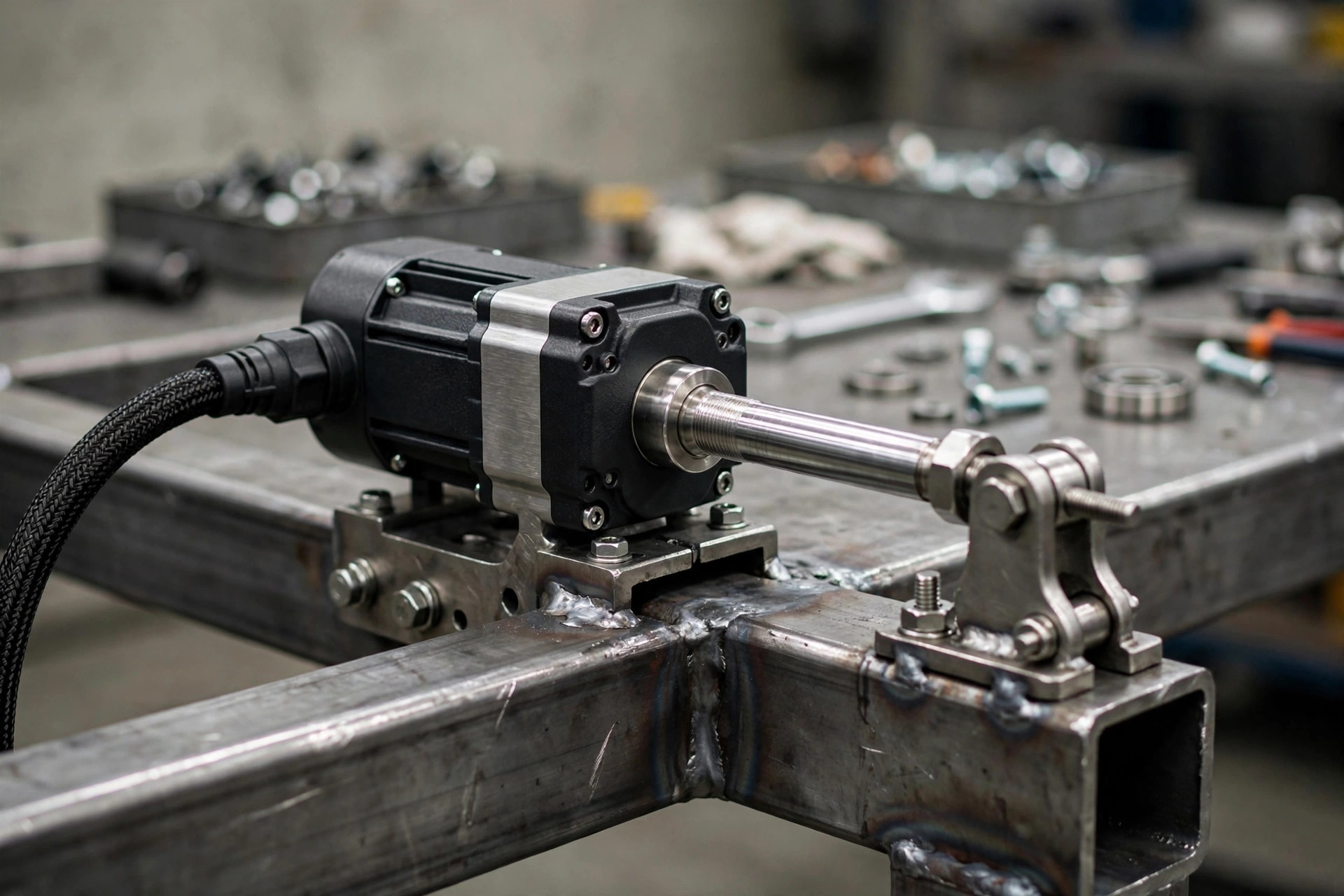
Illustrative AI-generated close-up of actuator hardware — not a photograph of a specific KCAI motor.
The questions buyers forget to ask
Beyond the datasheet, these questions separate serious motor specifications from catalog shopping:
- Under maximum rated load? Test data at no load is meaningless. Ask for noise, speed, and current-draw behavior at the bed's maximum rated load.
- After long idle periods? Beds in guest rooms sit unused for months. Does the actuator start smoothly after idle, or does it stick and jolt?
- Control system pairing? The actuator, control box, and remote are a system. KCAI pairs its motors with wired/wireless remotes, app and mini-program control, voice control, and smart-home integration (Huawei, Xiaomi, Alibaba, Tuya, Amazon IoT) depending on configuration — verify the whole chain, not just the motor.
- Spare parts availability? A quality motor from a manufacturer that disappears is worse than a decent motor with a ten-year parts pipeline. Ask about spare actuator availability before you sign, not after the first failure.
- What changed since the test? If the supplier shows cycle-test data, confirm the tested configuration matches the production configuration — same motor model, same mounting, same control box. Change control matters for motors too.
Specifying actuators in your RFQ
Make the motor a line item, not an assumption. Your RFQ should name the acceptable actuator sources (or the minimum documentation standard: manufacturer traceability, cycle-test data for the installed system, noise behavior under load), state the required cycle-test threshold, and require that any motor substitution triggers re-approval. The factory that welcomes this specificity is the factory you want building your beds. Browse the electric adjustable bed base range to see the platforms these motors drive.
Next step: choose the motor your warranty budget can live with
Motor quality is a warranty decision disguised as a purchasing decision. Specify established, documented actuators, demand the test data, model the total cost — and never let the motor be the silent line item in someone else's quote.
Two ways to work with KCAI:
Path 1 — Wholesale proven platforms. Buy models running German OKIN or Haojiang actuators — KD010-A2, KD011-A3, KD001-A3, KD008-A1 — with 10,000+ cycle aging-test verification behind the lifting system. Discuss which motor configuration fits your program in your quote request.
Path 2 — OEM/ODM customization. Building a custom platform? Our OEM/ODM services let you specify the actuator, control system, and test protocol as part of the development program — motor selection documented in the golden sample, not decided on the production floor.