The short answer: the 10,000-cycle test drives an adjustable bed's lifting system through more than ten thousand complete raise-and-lower cycles under load — compressing years of nightly adjustments into a lab procedure — and checks that the actuators, hinges, joints, and frame survive it. KCAI runs this aging test on every bed-frame lifting platform before release (the KD001-B2 electric mattress goes further, to 15,000+ cycles). For buyers, the cycle count is the single most comparable durability evidence across suppliers: it is measured, dated, and falsifiable, unlike every adjective in a brochure. This guide explains what a cycle is, how labs run the test, why you should always demand the data, and how to read it without fooling yourself. For the engineering context, see our adjustable bed actuator engineering buyer's guide.
What a "cycle" actually means
A cycle is one complete round trip of the moving system: backrest from flat to raised and back to flat, leg section through its travel and back — under a defined load, at a defined speed, with defined dwell times. The details matter enormously:
- Load condition. A cycle at no load proves almost nothing; the test load should represent real use, including a safety margin. Ask what load the cycles were run at.
- Full travel vs. partial. Full-stroke cycles stress the mechanism's extremes (end stops, maximum leverage angles); partial cycles don't. KCAI frames adjust through backrest 0-60° and leg rest 0-40° — the test should exercise that full range.
- Dwell and speed. Real users pause mid-position and adjust at remote-control speed, not lab-maximum speed. An honest protocol reflects real operating conditions.
- What counts as a failure. The pass criteria must be defined before the test: actuator still drives rated load, no structural cracking, hinges within tolerance, electronics functional. A test without pre-defined failure criteria is a demonstration, not a test.
When a supplier quotes a cycle number, these four parameters are the difference between a meaningful result and a number on a slide. Always ask for the protocol, not just the headline.
How labs run the 10,000-cycle test
A proper durability program follows a sequence, not just a cycle count:
| Phase | What happens | What it reveals |
|---|---|---|
| Pre-test inspection | Full dimensional and functional baseline of the unit | The "before" picture — without it, post-test findings are arguable |
| Cycling | Automated rig drives 10,000+ full cycles under load, with periodic inspection stops | Wear progression: when does noise increase, when do tolerances drift |
| Interim checks | Functional tests at defined intervals (e.g., every 2,000 cycles) | Whether degradation is gradual (acceptable) or sudden (a design flaw) |
| Post-test teardown | Disassembly and inspection of actuators, gears, hinges, welds, brackets | The internal wear story the exterior hides |
| Environmental overlay (good labs) | Some programs add humidity, temperature cycling, or dust | Real bedrooms aren't clean rooms; neither should the test be |
The interim checks deserve emphasis: a mechanism that degrades linearly to 10,000 cycles is a different product than one that performs perfectly for 9,500 cycles and then fails catastrophically. The shape of the wear curve is as informative as the final number — ask whether the lab recorded it.
KCAI conducts its testing under lab protocols associated with CNAS/SGS/TUV/UL at its Dongguan facility — a 25,000 sqm factory operating since 2004, serving 100+ global customers. The institutional point matters: cycle testing is only as trustworthy as the lab running it and the quality system around it.
Why buyers should always ask for cycle-test data
Three reasons, in ascending order of commercial importance:
1. It is the only comparable durability metric. Every supplier claims durability; almost none can show you the same measured number. Cycle-test data with a defined protocol lets you compare supplier A against supplier B on something other than price and promises.
2. It predicts your warranty curve. Warranty provisions are set from expected failure rates. A platform verified to 10,000+ cycles gives your finance team a defensible basis for provisioning; a platform with no test data forces a guess — and warranty guesses err expensive.
3. It reveals the supplier's engineering culture. A factory that cycle-tests as a matter of course, documents the protocol, and shares the report is a factory that designs for the field. A factory that treats the request as unusual is telling you durability is not part of its development process. The test report is a window into how the product was made.
Practical note: request the data in the RFQ, before pricing discussions. Suppliers who must scramble to produce test documentation after you've shortlisted them will produce something — but it won't be as trustworthy as documentation that existed before you asked.
What 10,000 cycles means in years of use — carefully
Buyers always ask, so here is the honest framing: cycle count is a methodology for comparing durability, not a lifespan promise. No responsible manufacturer converts it directly into a "lasts X years" claim, because real lifespan depends on user weight, adjustment frequency, environment, maintenance, and luck.
That said, the arithmetic is instructive as a sense-check only — not as any kind of lifespan promise. Consider a user who adjusts the bed a handful of times per day — morning flatten, evening raise, a position tweak or two. At that pace, 10,000 cycles represents a very large number of days of use: far beyond what most consumers will ever demand of the mechanism. The test's real message is margin — the mechanism was verified far past typical lifetime demand, which is exactly what you want in a product you warranty.
Two guardrails for using this math:
- Never put a year number in customer-facing materials derived from cycle math. It is an internal sense-check, not a claim. Warranty terms are a separate commercial decision.
- Cycles are necessary, not sufficient. A 10,000-cycle mechanism in a frame with weak welds, or paired with unverifiable electronics, is still a risky product. Durability is a system property — which is why the test must cover the system, not just the motor.
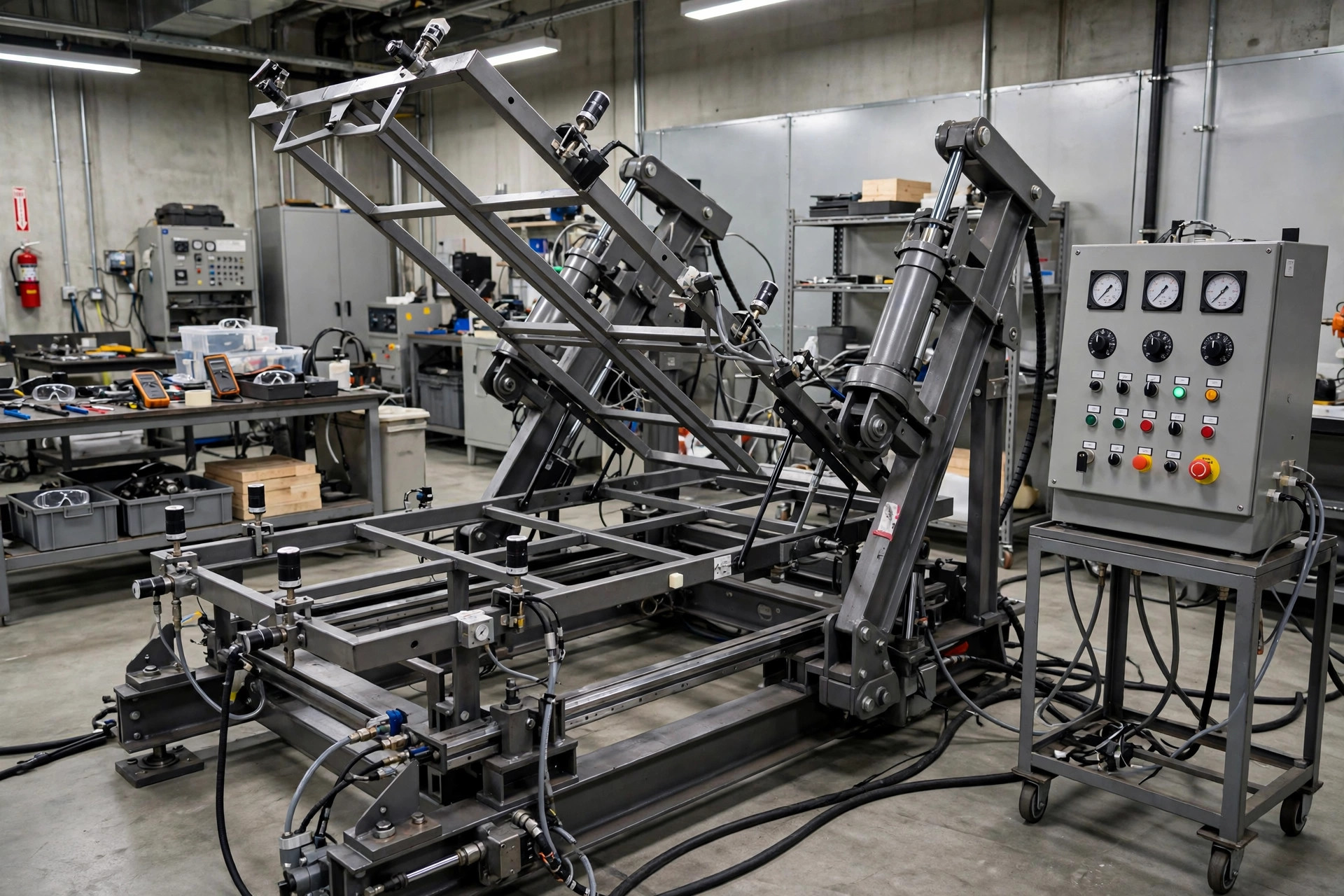
Illustrative AI-generated testing-lab scene — not a photograph of actual KCAI testing.
Beyond the motor: testing the whole system
The actuator usually gets the attention, but a complete durability program covers every wear point in the load path:
- Hinges and pivots. The backrest and leg hinges cycle with every adjustment. Check for play developing, pin wear, and bracket fatigue — the teardown inspection should photograph these.
- Frame joints. Split-frame designs (like KCAI's KD010-A2 and KD011-A3) add engineered joints to the load path; the cycle test must be run on the as-assembled knock-down configuration, not on a welded prototype.
- Mounting brackets. Actuator mounts see the full thrust load every cycle. Bracket cracking is a classic late-life failure — exactly what 10,000 cycles is meant to catch.
- Control electronics and remotes. Buttons, cables, and control boxes have their own wear modes. A full program cycles the controls through the same count, or tests them to their own standard.
- Upholstery and deck interface. On upholstered and mattress-integrated platforms (KD001-B1, KD001-B2, KD002-B1, KD004-B1), the deck-to-mattress interface moves too — verify it was part of the test article.
When reviewing a test report, check the test article description first: what exactly was cycled? A report on the motor alone, presented as a report on the bed, is the most common form of durability theater in this industry.
Making test data part of your RFQ
Add these lines to every adjustable-bed RFQ, and keep the responses on file:
- Cycle-test requirement. "Lifting system shall be verified to a minimum of 10,000 full-load adjustment cycles per a documented protocol; test report to be provided."
- Protocol disclosure. Load condition, travel range, speed, dwell, interim inspection intervals, and pre-defined pass/fail criteria.
- Test article definition. The exact configuration tested — model, actuator brand and model, control system, and (for knock-down designs) the as-assembled configuration.
- Lab and date. Who ran it, when, and under what quality system.
- Change control. Any change to actuator, hinge, joint, or control system design triggers re-testing or documented engineering justification.
Suppliers who meet this specification without blinking are the suppliers whose products survive the field. Explore the electric adjustable bed base range to see platforms developed under this discipline.
Next step: demand the data
Durability you cannot measure is durability you cannot buy. Before your next sourcing decision, ask every shortlisted supplier for cycle-test documentation — protocol, test article, results, lab, date — and compare the answers side by side. The suppliers with real data will welcome the question.
Two ways to work with KCAI:
Path 1 — Wholesale tested platforms. Buy bed-frame platforms with 10,000+ cycle aging-test verification (KD001-B2 electric mattress: 15,000+ cycles), German OKIN and Haojiang actuators, and lab testing under CNAS/SGS/TUV/UL protocols. Request the test documentation overview with your quote request.
Path 2 — OEM/ODM with testing built in. Developing a custom platform? Our OEM/ODM services include durability testing in the development program — protocol agreed at the design stage, results delivered with the golden sample, so your warranty model rests on measured data from day one.