Every year, upholstered beds are stopped at borders not because of what they are, but because of what their paperwork fails to prove. A container held for three weeks while a laboratory re-tests fabric samples; a retail chain rejecting a delivery because the foam test report references a different density than the production batch. The real cost is demurrage, a missed selling season, and a buyer who now treats your shipments as high-risk.
Material compliance is not a one-time certificate. It is a documentation discipline: knowing which documents exist for foam, fabrics, adhesives, and board components, who issues them, and how to read them before your supplier's claims become your liability. This guide covers what to request, how to verify it, and how a factory should manage it. For the broader program, our adjustable bed compliance and quality-control guide extends this discipline to electrical certifications and pre-shipment QC.
The documentation package: what to request for every material
An upholstered bed is a bill of materials before it is a product. Each material — foam, fabric, adhesive, board, steel — carries its own documentation, and one missing line can hold up the finished bed. Request the full package before the order is placed, not when the container is loaded. Retroactive documentation is where mismatches hide.
The table below is the request list to send with your RFQ. Every standard number is an industry reference — the exact standards for your SKU depend on the product category and destination market, so confirm them against current regulations and request KCAI's official spec sheet for the exact model.
| Material | Document to request | Who issues it | How to verify it |
|---|---|---|---|
| Polyurethane foam (cushioning) | Flammability test report (industry reference: California TB 117-2013; UK BS 5852) | Accredited third-party test laboratory | Confirm the lab's accreditation covers the cited method; check the report date and that foam density and grade match your order |
| Upholstery fabric | Ignitability test report (industry reference: EN 1021-1 & -2) plus substance screening declaration (industry reference: OEKO-TEX Standard 100) | Accredited laboratory / certification body | Verify the certificate number in the certifier's public database; confirm the fabric composition and colorway match your specification |
| Adhesives | Safety Data Sheet (SDS) and VOC / formaldehyde content declaration | The adhesive manufacturer | Check the SDS issue date and confirm the named product is the one used in production |
| Wood-based board (multi-layer panel) | Formaldehyde emission test report (industry reference: E1/E0; CARB Phase 2 for the US) | Accredited laboratory | Verify the standard edition cited; request the exact panel grade on the bill of materials |
| Finished upholstered bed (market access) | Declaration of Conformity (industry reference: EU General Product Safety Regulation; UK Furniture and Furnishings (Fire) (Safety) Regulations) | The supplier or manufacturer (self-declaration) | Cross-check every cited standard against an actual test report — a declaration that cites nothing is just paper |
| Full bill of materials | Complete substance and material declaration | Supplier engineering or QA department | Trace each line to a test report or declaration; flag "equivalent material" substitutions for re-verification |
Two rules govern this table. Documents are article-specific: a certificate for one fabric colorway does not cover another, and a foam report for one density does not cover a substitution. And the package is only as strong as its weakest document — one unverifiable report can sink a shipment.
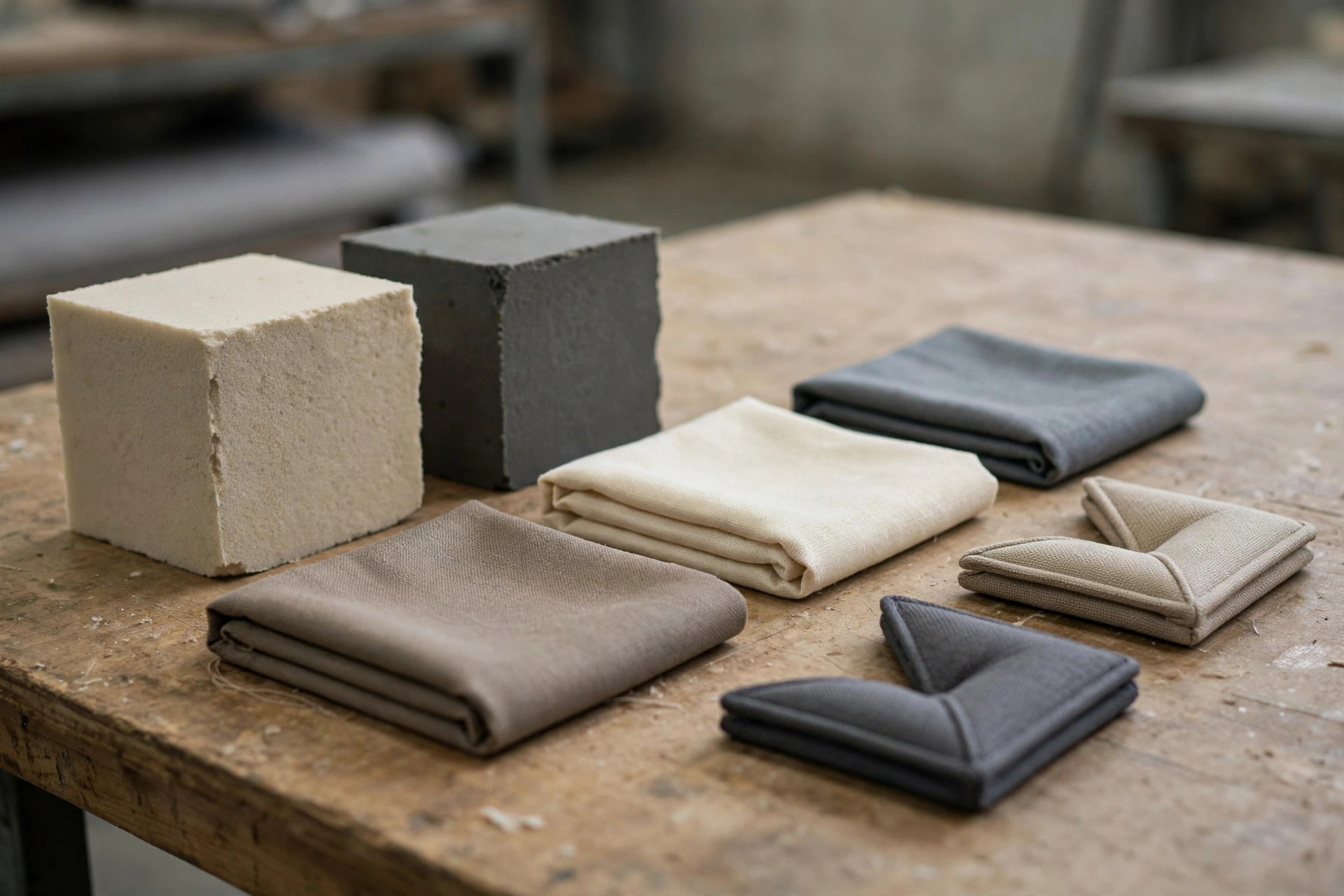
Illustration: generic foam, fabric, and edge samples for reference — a scene illustration, not a KCAI product photo.
Standards you will encounter, market by market
The same upholstered bed faces entirely different documentation demands in Los Angeles, London, and Berlin — and a supplier whose paperwork was built for one market may be silently unprepared for another. Below is what buyers typically encounter; treat every standard number as an industry reference and confirm the current edition with your compliance advisor.
United States. Buyers encounter the federal flammability standard 16 CFR 1633 (industry reference) for mattresses and sleep products, and California's TB 117-2013 (industry reference) for upholstered furniture components — many US retailers apply it nationally as a de facto requirement. Wood-component buyers also face CARB Phase 2 formaldehyde limits (industry reference) for composite panels. Retailer vendor manuals frequently add restricted-substance lists on top of the legal minimum: the legal standard clears customs; the retailer's list gets you onto the shelf.
European Union. The framework is the General Product Safety Regulation (industry reference), under which fabric ignitability is commonly assessed against EN 1021-1 and EN 1021-2 (industry references). Chemical obligations flow through REACH, including the Substances of Very High Concern (SVHC) candidate list (industry reference), which buyers increasingly require suppliers to screen and declare. Expect EU buyers to ask for a substance declaration alongside the flammability paperwork — the two answer different questions, and one never substitutes for the other.
United Kingdom. The UK maintains its own regime: the Furniture and Furnishings (Fire) (Safety) Regulations (industry reference), with testing commonly performed to BS 5852 (industry reference). EU-market documentation does not automatically satisfy UK requirements — confirm the regulatory basis on every report matches the market of sale.
Other markets. Australia, the Middle East, and Southeast Asia layer national requirements over the references above, and requirements change. The move is the same everywhere: define the destination market in the RFQ, require the supplier to name the standards claimed, and verify each claim independently.
One boundary worth stating plainly: this guide covers upholstered beds for residential, hospitality, and home-care settings — lifestyle ergonomics and home-care elevation support, not medical beds or hospital beds. Adjustable positioning may help users sit up, read, or rest more comfortably, but that is not a substitute for medical treatment; advise consulting a physician for medical needs.
How to read a supplier's documents: five checks
Collecting documents is the easy half. Apply these five checks to every report before approving production.
1. Scope match. Does the report describe the exact material in your SKU? Compare the tested article — foam density and grade, fabric composition and weight, adhesive product name, board grade — against your bill of materials. The most common failure is not a forged report; it is a genuine report for a slightly different material. A cost-driven density substitution silently invalidates the foam report it was filed under.
2. Dates and validity. Compare the report date against your production window, and check whether the cited scheme has an expiry or re-testing interval. A three-year-old report for a material reformulated last year documents the old material, not the one in your container. Ask when the formulation last changed and whether the report postdates that change.
3. Laboratory accreditation. Verify that the issuing lab holds recognized accreditation (industry reference: CNAS, ILAC-MRA signatory bodies) and that its scope covers the specific test method cited — an accredited lab testing outside its scope produces an unaccredited result. Most accreditation bodies publish searchable scopes online; use them.
4. Standard edition. A report citing a superseded edition may not satisfy a current regulation or retailer manual. Check the edition year and confirm it is the edition your market currently recognizes — a frequent source of "valid report, rejected shipment" outcomes.
5. Traceability to the production run. The package should connect documents to product: batch or lot references, production dates, and a chain of custody for third-party materials. If the supplier cannot show which production run a report's samples came from, the report documents a sample, not your shipment. For reorders, require the same documented configuration — substitutions without updated documentation are the fastest way to turn a compliant program non-compliant.
Stop the order on these red flags: photocopied reports with redacted lab details, reports describing a different product, certificate numbers that do not resolve in public databases, and "certification pending" offered as documentation. Pending is not a document.
How a factory should manage material documentation
Documentation discipline is a factory operations problem. A factory that manages materials properly produces documentation as a byproduct of its process; one that does not will always be scrambling.
At KCAI Intelligent Sleep, the upholstery build uses confirmed materials: high-density foam for cushioning, 15/18mm eco multi-layer board for structural panels, optional fabric choices per market program, quality steel for the frame, and high-strength honeycomb aluminum panel where the design needs a rigid, lightweight core. The mechanism runs on German OKIN or Haojiang actuators — gentle rise and lower, low-noise, energy-saving — and the lifting system passes 10,000+ cycle aging tests. That matters more in an upholstered bed than a bare base: servicing a mechanism buried in finished furniture is expensive, so reliability is engineered in, not inspected in.
The practices buyers should expect — and ask about on any factory audit:
- Approved material lists. Each material is approved against the destination market's documentation requirements before production, so the paperwork package is defined at the engineering stage, not assembled afterward.
- Batch traceability. Materials trace from incoming batch to finished bed — without this, no test report can be tied to a shipment.
- Substitution control. Any material change — foam density, fabric dye lot, adhesive supplier — triggers re-verification of the affected documents before it enters production.
- Per-run documentation archiving. The documentation package is archived against its production run, so reorders reproduce the same documented configuration.
Put these questions to any upholstered bed supplier: show me the approved material list for my market, show me how a batch traces to a report, and show me what happens when a material changes. KCAI has manufactured sleep products in Dongguan since 2004, operates a 25,000 sqm factory serving 100+ global customers, and tests to CNAS, SGS, TUV, and UL laboratory standards. For exact material documentation on a specific model, request KCAI's official spec sheet.
Two ways to source a compliant upholstered bed program
Set documentation requirements before choosing the sourcing path — the path determines when the paperwork gets built.
Path 1 — OEM/ODM customization. Put your destination markets and documentation requirements in the RFQ, and engineering aligns material selection — foam grade, fabric program, board specification, adhesive system — from the start. This is the path for proprietary upholstery designs, market-specific fabric programs, or integration with your existing collection. The OEM/ODM process runs from requirement discussion through design, sample confirmation, and mass production, with the documentation package built alongside the product. Buyers evaluating the mechanism underneath can look at our electric adjustable bed base line, which shares the same motor platforms and testing discipline.
Path 2 — Wholesale of existing models. Select a proven model and inherit its documented configuration — same materials, same reports, same traceability. This is the fastest route when the existing design fits your assortment: no development cycle, a known bill of materials, and a documentation package that already exists. Confirm in writing that the wholesale SKU ships in exactly the documented configuration, and that future material changes will be disclosed with updated documentation before shipping.
Either path starts the same way: send documentation requirements with the RFQ, not after the quotation.
Frequently Asked Questions
Which documents should I request from an upholstered bed supplier before placing an order? At minimum: foam and fabric flammability test reports, a fabric substance screening declaration, the adhesive safety data sheet, board formaldehyde test data, and a Declaration of Conformity that cites actual reports. Request the full set before the order is placed — retroactive documentation is where mismatches hide.
Do foam and fabric need separate test reports? Yes. Foam and fabric are tested under different methods and often by different laboratories. A fabric certificate never covers the foam inside the cushion, and vice versa. Verify that each report describes the exact material grade, density, or composition used in your SKU.
A supplier quoted "certified fabric" under an industry scheme. What should I check? Schemes such as OEKO-TEX Standard 100 are industry references for textile substance screening, not government approvals. Ask for the certificate number, product class, and validity dates, then verify the number in the certifier's public database. Confirm the certified article matches the fabric specified for your order — certifications are article-specific, not company-wide. For KCAI's exact material documentation on a specific model, request the official spec sheet.
How can I tell whether a test report is genuine and current? Check four things: the issuing laboratory's accreditation and scope, the report date against your production window, the standard edition cited, and that the tested article matches your material specification. Photocopied reports with redacted sections, reports for a different product, and "certificate pending" promises are the classic red flags.
Can KCAI provide material documentation for OEM/ODM and wholesale orders? Yes. For OEM/ODM programs, material selection is aligned with your market's documentation requirements from the engineering stage, and documentation is archived per production run so reorders reproduce the same documented configuration. The same package applies to wholesale of existing models. Contact us to request the documentation checklist and the official spec sheet for your target model.
Build the paperwork before you need it
Material compliance rewards buyers who treat it as a procurement input, not a shipping afterthought. Define the documentation package in the RFQ, verify every report with the five checks above, and audit the factory's material controls — not just its certificates. Our adjustable bed compliance and quality-control guide extends this discipline to electrical certifications and pre-shipment inspection.
Two ways to move forward with KCAI Intelligent Sleep. OEM/ODM: bring your market's documentation requirements and design brief — our engineering team aligns materials, mechanism, and paperwork from day one. Explore the OEM/ODM process. Wholesale: select a proven model and ship in its documented configuration this season. Either way, request a quote and tell us your destination markets — and contact us to request the documentation checklist and the official spec sheet for your target model.