Your marketplace listing is removed on a Friday afternoon. No warning — the platform flagged the phrase "eliminates snoring" buried in your product copy. Across the channel, a retail buyer holds back payment on a container of adjustable bases because the packaging promises relief for sleep apnea, and their compliance team will not clear it. These are not edge cases. Distributors lose real money every quarter when sleep-feature marketing drifts into medical-claim territory. The exposure is threefold: platform takedowns that erase ranking momentum, retailer chargebacks and delistings, and regulatory action when a bed is perceived as an unapproved medical device. This guide gives procurement and marketing teams a claim-safe language framework for anti-snore and wellness features — what you may say, what you must never say, and the documentation habit that keeps every listing defensible.
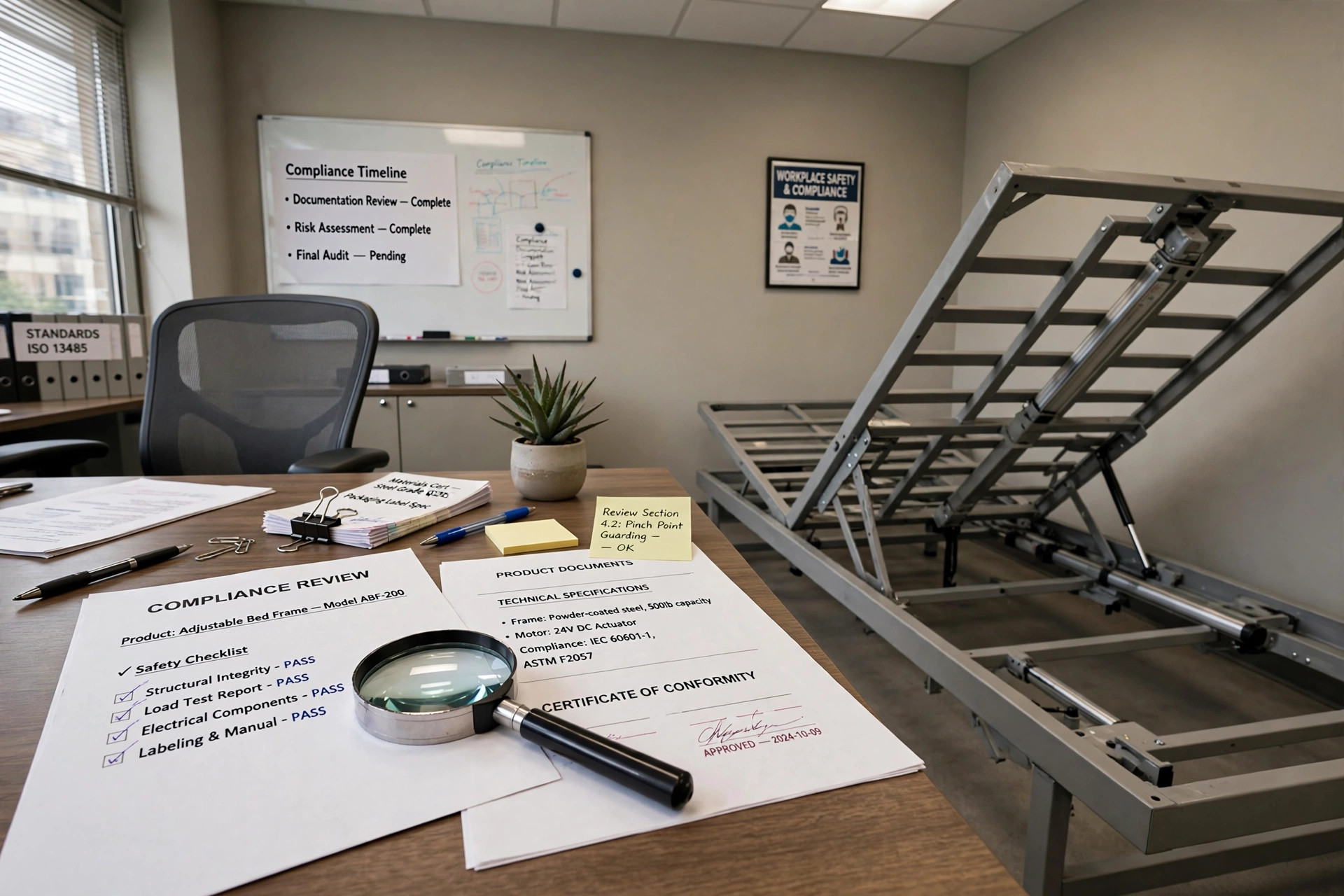
Cover: illustrative scene depiction — not a photograph of a KCAI product.
Where Regulators Draw the Line
The dividing line is simpler than most distributors think. In the United States, a product marketed to diagnose, treat, cure, mitigate or prevent a disease is regulated as a medical device — an industry-reference framework under FDA 510(k) rules. In Europe, the EU MDR draws a comparable boundary. Your adjustable bed does not need to be designed as a medical device to be treated as one by a regulator: it only needs to be marketed like one.
That is the trap. Words such as cure, treat, eliminate, stops, prevents, heals and clinical, when attached to snoring, sleep apnea, back pain, poor circulation or insomnia, convert comfort marketing into a medical claim. The same applies to indirect phrasing: "doctor-recommended for apnea sufferers" or "clinically proven to end snoring" triggers the same scrutiny even when no clinical study exists. Testimonials are not exempt — a customer review claiming the bed cured a condition, published on your listing, is treated as your claim in most markets.
Positioning language matters just as much as feature language. Never position an adjustable bed as a medical bed or hospital bed. Those categories carry their own regulatory regimes, and borrowing their vocabulary imports their risk. The safe zone is lifestyle ergonomics: positioning, comfort, relaxation and home-care elevation support. Everything in this guide keeps your copy on that side of the line.
The Claim-Safe Vocabulary Distributors May Use
Claim-safe language does not mean featureless language. It means describing real engineering in words that promise no medical outcome. Build your vocabulary around these approved patterns:
Anti-snore head incline. Describe it as a lifestyle-ergonomics position preset. "An elevated head position may help keep airways open during sleep" is defensible. "Eliminates snoring" is not. The word "may" does real legal work — it frames the feature as a possibility, not a therapeutic result.
Posture alignment and comfort positioning. "Supports a neutral spine position while reading or resting" describes geometry, not medicine. Avoid connecting posture language to diagnosed back conditions.
Zero-gravity and relaxation presets. "Distributes body weight across the frame for a weightless-feeling rest position" is a comfort description. Do not extend it into circulation, blood pressure or swelling claims.
Vibration massage. "Gentle vibration for relaxation" is safe. The moment the copy suggests therapy — relief, recovery, treatment of soreness — it has crossed the line.
Memory one-touch reset, reading and viewing modes. These are convenience features. "One-touch memory returns the bed to your preferred position" promises an action of the mechanism, which is exactly the kind of claim you can always make: claims about what the hardware does, never claims about what the body experiences as a result.
One final rule: never let "may" drift into "will." "May help you relax" is lifestyle language; "will fix your sleep" is a promise. Train your copy team on that one-letter difference — it is where most enforcement cases begin.
Claim Do / Don't Table: Feature by Feature
Use this table as the reference your listing team checks before publishing. It covers the feature names KCAI offers as configurable presets — deep sleep, zero-gravity, memory one-touch reset, anti-snore, vibration massage, reading and viewing — described strictly as lifestyle-ergonomics options with no medical promises.
| Feature | Say this (claim-safe) | Never say this |
|---|---|---|
| Anti-snore head incline | "Anti-snore head incline: an elevated position preset that may help keep airways open during sleep." | "Stops snoring," "cures snoring," "treats sleep apnea" |
| Zero-gravity preset | "Zero-gravity comfort position distributes weight for a weightless-feeling rest." | "Improves circulation," "relieves swelling," "reduces blood pressure" |
| Vibration massage | "Gentle vibration massage for relaxation." | "Therapeutic massage," "relieves pain," "speeds recovery" |
| Memory one-touch reset | "One-touch memory returns the bed to your saved position." | "Clinically designed positions for spinal health" |
| Deep sleep mode | "Deep sleep preset: a gentle recline designed for comfortable, restful positioning." | "Guarantees deeper sleep," "treats insomnia" |
| Reading / viewing modes | "Upright presets for comfortable reading and screen viewing." | "Doctor-recommended posture," "corrects posture disorders" |
| Posture alignment | "Supports neutral-spine positioning while resting." | "Fixes back problems," "eliminates back pain" |
If a sentence promises a change in a body condition, it fails the test. If it describes what the mechanism does or how a position feels, it passes. When in doubt, rewrite the sentence so the subject is the bed, not the body: "the bed elevates the head section" is always safer than "your breathing improves."
What Compliant Documentation Looks Like
Claims are only half of the exposure. The other half is substantiation — what you can show when a platform, retailer or regulator asks why a sentence is on your listing. Compliant distributors keep a documentation package for every feature claim. Compare your current practice against this checklist:
| Element | Claim-safe practice | Risky gap |
|---|---|---|
| Specification source | Every number comes from the manufacturer's official spec sheet; unconfirmed figures are replaced with "request the official spec sheet" | Copying specs from a competitor listing or a marketplace page |
| Claim substantiation | Feature descriptions match engineering facts (preset names, angles, materials) | Marketing phrases with no engineering source |
| Disclaimer | Every sleep/wellness listing states the product is not a substitute for medical treatment and advises consulting a physician or sleep specialist for diagnosed conditions | No disclaimer, or a disclaimer hidden below the fold |
| Standards references | Only verifiable certifications are cited; industry benchmarks (UL 962, 16 CFR 1633, CE-LVD) are labeled as industry reference, never as the manufacturer's own certification | Presenting benchmark standard numbers as product certifications |
| Imagery | Lifestyle-ergonomics scenes; AI-generated scenes are labeled as illustrative, never presented as product photography | Medical-looking imagery (crosses, clinical settings, "as seen in hospitals") |
| Testimonials | Screened for disease-outcome language before publishing | Unedited reviews claiming cures, published verbatim |
| Packaging and inserts | Same claim rules as the listing; QR code to the official spec sheet | Retail packaging promising outcomes the listing does not |
Treat this table as an audit tool. Run every active listing through it once per quarter, and run every new listing through it before it goes live. The fifteen minutes it costs is the cheapest insurance a distributor carries.
How KCAI Engineers Claim-Safe Features
A supplier makes claim-safe marketing easy when its feature set is engineered around positioning and comfort rather than therapeutic promises. KCAI Intelligent Sleep has manufactured adjustable bed bases since 2004 from a 25,000 sqm facility, supplying 100+ global customers as an OEM/ODM partner. Its bed modes — deep sleep, zero-gravity, memory one-touch reset, anti-snore, vibration massage, reading and viewing — are offered as configurable feature names: lifestyle-ergonomics position presets, described without medical promises.
The engineering behind them is documented, not asserted. Drive systems use OKIN (German) and Haojiang motors specified for gentle rise/lower motion, low-noise operation and energy-saving characteristics. The lifting system is validated with 10,000+ cycle aging tests. Construction uses high-density foam, 15/18mm eco multi-layer board, high-strength honeycomb aluminum panel and quality steel — materials a distributor can name in marketing copy because they are confirmed in the official specification. Finished products are CNAS·SGS·TUV·UL lab-tested.
This matters for compliance because every claim in this guide's vocabulary traces back to a documented engineering fact: a motor that moves gently, a frame that holds a position, a preset that returns to a saved angle. When your supplier gives you facts instead of adjectives, your listings write themselves inside the safe zone. For full technical parameters and the documentation package behind them, request the official spec sheet — never substitute numbers from a marketplace listing.
Building a Claim Review Workflow for Your Listings
A vocabulary is useful; a workflow is enforceable. Here is the six-step review that compliant distributors run on every listing, assembled from the enforcement patterns above and from the adjustable bed compliance and quality control guide, which covers the factory-side testing and inspection framework behind these products:
- Source every specification from the official spec sheet. If a number is not in the sheet, the listing says "request the official spec sheet." No exceptions for angles, load ratings or dimensions.
- Run a banned-word scan. Flag cure, treat, eliminate, stops, prevents, heals, clinical, medical, hospital, doctor-recommended and therapeutic. Rewrite or remove every hit.
- Check the disclaimer. Every page mentioning sleep, comfort or wellness carries the statement: this product is not a substitute for medical treatment; consult a physician or sleep specialist for diagnosed conditions or persistent symptoms.
- Review imagery and video. No clinical settings, no medical symbols, no "as used in hospitals." AI-generated lifestyle scenes must be labeled as illustrative.
- Vet testimonials and UGC. Any customer content claiming a disease outcome is edited to comfort language or removed.
- Align packaging and inserts. The retail box, the manual and the listing must tell the same claim-safe story — enforcement does not stop at the URL.
Distributors who want a head start can contact KCAI to request the claim-safe word bank, the RFQ template and the official spec sheets for current models. These assets are provided on request so your team always works from the current, factory-confirmed source.
Frequently Asked Questions
Can we say our adjustable bed stops snoring?
No. "Stops" promises a medical outcome and turns your listing into a regulatory risk. Say instead that an anti-snore head incline is a lifestyle-ergonomics position preset that may help keep airways open during sleep, and advise buyers with persistent snoring to consult a sleep specialist. The feature is real; the promise must stay modest.
Do we need a disclaimer on every product page?
Yes. Any page that mentions sleep, comfort or wellness features should state that the product is not a substitute for medical treatment, and that readers with diagnosed conditions or persistent symptoms should consult a physician or sleep specialist. One sentence, visible above the fold, protects every other sentence on the page.
Can we publish a customer testimonial that says the bed cured their back pain?
No — at least not as written. In most markets, testimonials published on your listing are treated as your marketing claims. Edit the testimonial to describe comfort and positioning ("I wake up more comfortable"), or remove it. "Cured" language triggers the same enforcement as copy you wrote yourself.
Can we reference certifications or standards in our marketing?
Only verifiable, published certifications. Industry benchmarks such as UL 962, 16 CFR 1633 or CE-LVD are industry reference only — never present them as KCAI certifications. If a retailer asks for proof of a specific certification, request the official spec sheet and documentation package from the factory rather than citing standard numbers from memory.
When must we advise buyers to consult a sleep specialist?
Whenever your copy touches sleep apnea, diagnosed conditions, chronic pain or persistent symptoms — even indirectly. Phrases like "for serious snorers" or "if you have trouble breathing at night" already imply a condition. The referral protects the buyer and keeps your listing on the lifestyle-ergonomics side of the regulatory line.
Partner with KCAI Intelligent Sleep
Compliance is a supply-chain decision, not just a copywriting one. When your factory documents its engineering, labels its features honestly and hands you claim-safe language with the spec sheet, your listings stay live, your retailers stay paid, and your brand stays out of regulatory correspondence. KCAI Intelligent Sleep backs its OEM/ODM program and its electric adjustable bed base range with factory-confirmed documentation — from 10,000+ cycle aging-test validation to CNAS·SGS·TUV·UL lab testing — so your marketing team always has a defensible source.
Two partnership paths are open. OEM/ODM customization: configure bed modes, frame dimensions, materials and branding for your market, with factory documentation that supports your compliance file. Wholesale of existing models: source proven bases with official spec sheets, claim-safe feature descriptions and the word bank your listing team needs on day one. Review the compliance and quality control framework to see how factory-side testing underpins claim-safe marketing, then request a quote to start the conversation — and contact us to request the claim-safe word bank, RFQ template and official spec sheets for your evaluation.