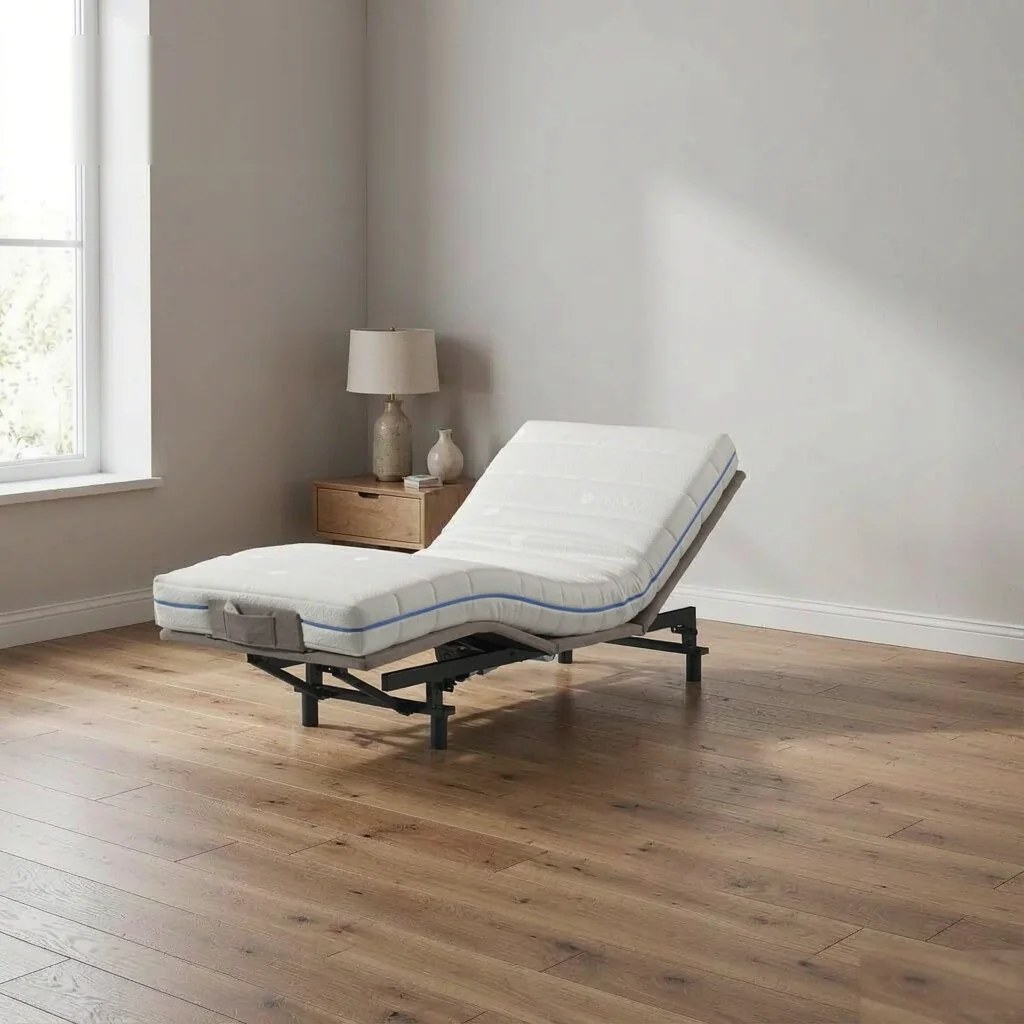
Ask any successful adjustable-base dealer what closes the sale on the showroom floor, and you will hear the same answer again and again: snoring. It is personal, it is emotional, and it affects the person standing next to the buyer — which means the purchase decision often involves two people, not one. For brands and distributors, the snoring story is one of the highest-converting narratives in the adjustable bed category.
This guide is written for procurement buyers and dealer teams. It covers why the snoring story sells, the mechanism in plain language, what the research actually shows, the features that make the demo work, and — critically — how to talk about all of it without making medical claims you cannot defend.
Why the Snoring Story Sells Bases
Snoring is close to universal. Industry surveys consistently find that a large share of adults snore at least occasionally, and a meaningful portion snore regularly. That makes it a mass-market entry point: almost every couple walking into a showroom has a snoring story.
Three things make it commercially powerful for dealers:
- Two decision-makers. The snorer and the partner who cannot sleep. One base solves both people's problem, which justifies a premium purchase far more easily than comfort alone.
- A demo that works in ten seconds. Press the anti-snore preset, the head rises, the customer feels the difference immediately. Few features in the furniture business demo this cleanly.
- Attachment rates. Trade publications report adjustable-base attachment rates of 30–50% on mattress sales, rising to 70–80% among top dealers. The snoring story is one of the main drivers: it reframes the base from "nice accessory" to "the reason we came in."
The Mechanism in Plain Language
Your sales staff does not need a physiology degree — they need a simple, accurate explanation. Here it is:
When a person sleeps flat on their back, gravity pulls the tongue and soft tissues of the throat downward. In some people, this narrows the airway, and the vibration of air passing through the narrowed space is what we hear as snoring. Raising the head of the bed changes the angle of the airway: gravity now works with the sleeper instead of against them, helping keep the tongue and soft palate from collapsing backward.
That is the whole story. Notice what it does not say: it does not promise that snoring disappears, and it does not mention sleep apnea as something the bed treats. The mechanism is positioning. The bed changes the sleeping position; the position may help reduce snoring. Keep the claim at the level of the mechanism and you stay on safe ground.
Two related points worth training into the team:
- Drainage and side sleeping. Head elevation can also help nasal drainage and makes side-sleeping positions more comfortable — both relevant to nighttime breathing comfort.
- Pillow stacking is the enemy. Many customers try to solve snoring by stacking pillows, which bends the neck and can actually make things worse. A base that raises the whole upper body keeps the spine aligned — a genuinely better solution, and a great contrast to demonstrate.
What the Research Shows
You do not need to be a researcher to sell this story — but citing real research is what separates a credible dealer from one making things up. Here is what the published literature says, in terms your team can use:
- A 2021 study published in Sleep Health found that elevating the head of the bed by 7.5 degrees reduced the severity of obstructive sleep apnea in mild-to-moderate cases, with improved oxygen saturation and fewer apneic events.
- A review in the Journal of Clinical Sleep Medicine found positional therapy, including head-of-bed elevation, effective at reducing apneic episodes — particularly for people who sleep on their backs.
- Published expert guidance on head elevation for apnea-related positioning ranges from around 20–30 degrees up to 30–45 degrees depending on the source. Present these as ranges cited in the literature, not as a prescription from your brand.
Three rules for using research in sales conversations:
- Attribute, don't assert. Say "a 2021 study in Sleep Health found..." — never "studies prove our bed..."
- Scope every claim. "In mild-to-moderate cases" belongs in the same sentence as any benefit statement.
- Refer out for the serious stuff. Suspected sleep apnea is a medical matter. "Please consult a sleep specialist" should be a trained reflex, not an afterthought.
The Features That Make the Story Credible on the Showroom Floor
A good story needs the right hardware behind it. When you are specifying which SKUs to carry — or which platform to build on — these are the features that make the snoring pitch work:
- One-touch anti-snore preset. The single most important feature for this story. A button on the remote that raises the head to a pre-programmed angle turns the demo into a ten-second moment. Make sure your supplier can program custom preset angles — KCAI's platforms support programmable presets that can be defined per project.
- Head tilt. Independent head-tilt articulation fine-tunes the airway angle beyond what the main backrest section does. It is a strong differentiator on higher-end SKUs.
- Split king for couples. The partner who doesn't snore keeps their side flat while the snorer elevates. This feature alone has closed countless sales — and it doubles the base in the ticket.
- Quiet motors. A base that groans and clicks at midnight undermines the entire sleep story. German OKIN and Haojiang actuators — the motors KCAI builds on — are specified for quiet, smooth operation.
- Memory settings. Let each sleeper save their position. It turns a one-time demo into a daily habit, which is what drives satisfaction and referrals.
- CPAP-friendly design. Many apnea patients already use CPAP machines. A base with a flat, stable sleeping surface and adjustable head section pairs naturally with CPAP therapy — position it as complementary, never as a replacement.
On the mechanism side, look for backrest articulation in the 0–60° range and leg rest in the 0–40° range — the full travel KCAI's KD010-A2, KD008-A1, and KD001-A3 platforms offer — so the preset angles your team demos sit comfortably inside the base's real capability.
Claim-Safe Talking Points for Your Sales Staff
Print this section and put it in the training binder. These are the exact phrasing patterns the industry's most careful sellers use:
- Do say: "Elevating the head may help reduce snoring." / "Many customers find the anti-snore position more comfortable for nighttime breathing."
- Do say: "This is designed for mild to moderate snoring. If you suspect sleep apnea, please consult a sleep specialist."
- Do say: "The bed changes your sleeping position — and position can make a difference to airflow."
- Don't say: "cures," "stops," "treats," or "eliminates" sleep apnea or snoring. Ever.
- Don't say: anything that positions the base as a medical device or a replacement for CPAP, dental appliances, or medical treatment.
The formula is simple: modal verbs (may, can), mechanism-first framing, scoped conditions, and a specialist referral. Train it until it is automatic, and your team can sell the snoring story aggressively without ever crossing a regulatory line.
Two Ways to Work With KCAI on Anti-Snore SKUs
When you are ready to put the snoring story into your lineup, KCAI offers two paths — pick the one that fits your timeline and strategy:
Wholesale our proven models. If you want to move fast, purchase existing KCAI platforms wholesale. Models like the KD010-A2 (split AI base, backrest 0–60°, leg rest 0–40°), the KD008-A1, and the KD001-A3 ship with programmable presets, quiet German OKIN and Haojiang motors, and the full feature set your showroom demo needs — anti-snore preset, head tilt options, split configurations, memory settings. Proven SKUs, no development cycle.
OEM/ODM manufacturing. If you want differentiation, partner with us to build your own. Preset angles, remote layouts, upholstery, branding, and feature combinations can be customized to your market. With a 25,000 sqm factory, 100+ global customers, and CNAS/SGS/TUV/UL testing behind every platform, KCAI has built adjustable beds since 2004 — the engineering depth is there for full custom programs, from first sample to mass production.
Either way, you get the same foundation: real motor technology, real test data, and a team that understands what a dealer needs on the showroom floor.
The Bottom Line for Buyers
Snoring sells adjustable bases because the demo is instant, the problem is universal, and the purchase usually involves two decision-makers. The dealers who win with this story do three things: they explain the mechanism in plain language, they cite real research with proper scoping, and they train their staff to sell hard on positioning while referring medical questions to specialists.
If you are building or refreshing an adjustable-bed lineup around the snoring story, start the conversation with our team. Partner with us for OEM/ODM manufacturing, or purchase our proven existing models wholesale — request a quote to discuss either path.