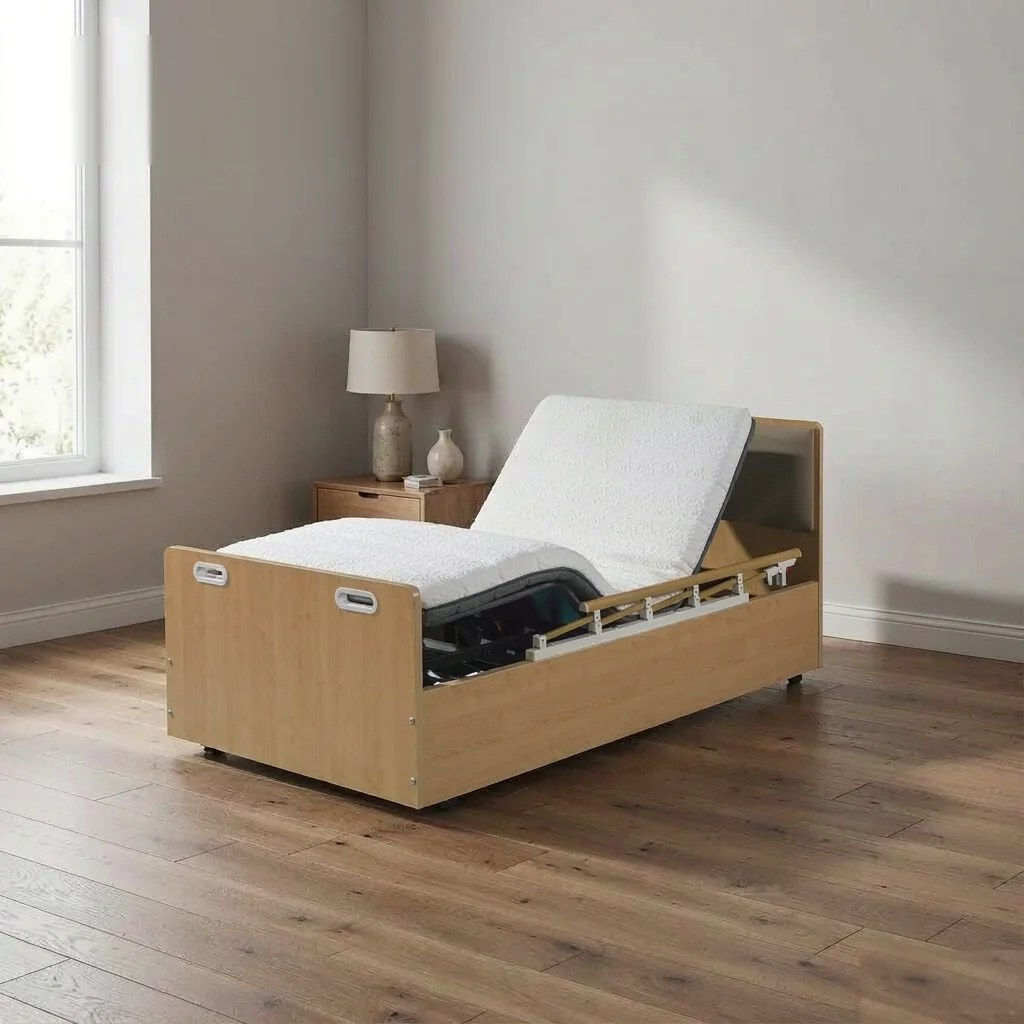
More patients are recovering at home after surgery, and families are equipping bedrooms for the weeks and months that follow. For home-care dealers, medical equipment distributors, and furniture brands, this shift creates a clear product opportunity: adjustable bed bases that support rest, repositioning, and caregiver access without turning a bedroom into a hospital ward.
This guide explains what recovery at home actually demands from a bed, which features your home-care SKUs should carry, and what to ask your factory — whether you plan to build your own branded line through OEM/ODM or move faster with wholesale of proven models.
Note: this article discusses product features for the trade. It does not provide medical advice. Positioning and recovery routines should always follow the guidance of the patient's healthcare providers.
Why home recovery is a category dealers should take seriously
Several forces are pushing recovery out of hospitals and into bedrooms. Shorter hospital stays, the growth of home-care services, and the simple preference of patients to heal in familiar surroundings all point the same direction. For dealers, that means steady demand for equipment that bridges the gap between a clinical hospital bed and an ordinary flat bed.
The winning products in this space share one trait: they handle the practical realities of recovery — frequent repositioning, getting in and out of bed safely, and caregiver access — while looking like furniture a family is happy to live with. Dealers who stock only clinical-looking beds miss the large segment of buyers who refuse anything that makes their home feel like a ward.
There is also a commercial logic worth noting. Home-care purchases are rarely impulse buys; they are researched, discussed with family members, and often recommended by discharge planners or home-care agencies. Dealers who can speak knowledgeably about positioning, transfers, and caregiver ergonomics — and who carry products that visibly deliver on those points — earn both the sale and the referral. Content like this guide doubles as sales training: share it with your floor staff and agency partners.
What recovery at home demands from a bed
Think about a typical recovery week. The person in the bed needs to change position often, sit upright for meals and medication, elevate the legs for comfort, and get in and out of bed multiple times a day — sometimes with limited strength or mobility. A caregiver may need to reach the patient comfortably, assist with transfers, and keep the sleep area clean.
A standard flat bed makes all of this harder. An adjustable base addresses each point mechanically:
- Head incline allows an upright or semi-upright resting position for reading, eating, and conversation, without stacking pillows that slip and strain the neck.
- Foot incline lets the user raise the legs for comfort and makes it easier to find a restful position.
- Full-frame hi-low height adjustment brings the whole bed to a height that suits transfers — whether the person moves independently, uses a walker, or transfers from a wheelchair — and gives caregivers a comfortable working height.
- Quiet motors matter more than most buyers expect. Nighttime adjustments should not wake the household.
- Locking casters and a stable frame keep the bed exactly where it is put, which matters when someone with limited mobility is getting in or out.
None of these features promise a medical outcome. They simply make the mechanics of a recovery routine easier — and that is exactly how dealers should present them.
Feature checklist for home-care SKUs
When you evaluate adjustable bed bases for a home-care assortment, run through this checklist with each candidate model:
- Incline ranges: head and foot sections should adjust smoothly across a useful range. Our bases, for example, offer backrest adjustment of 0–60° and leg rest adjustment of 0–40°, covering everything from slight elevation to a full seated position.
- Hi-low capability: true vertical adjustment of the whole frame, not just the mattress sections. Ask for the minimum and maximum heights in writing.
- Side rail compatibility: mounting points for assist rails. Confirm whether rails are included, optional, or third-party.
- Motor quality and noise: look for established actuator suppliers. We build with German OKIN and Haojiang motors, and our lifting systems pass 10,000+ cycle aging tests — ask any factory for equivalent durability evidence.
- Ease of cleaning: smooth, wipeable surfaces on frames and surrounds; removable, washable upholstery where applicable.
- Remote simplicity: large buttons, backlit controls, and ideally preset positions (flat, upright, zero-gravity) so elderly users are not navigating complex menus.
- Weight capacity options: confirm the standard rating and ask what reinforced configurations are available.
- Bedroom-friendly design: slim profiles, upholstered surrounds, and finishes that sit naturally next to ordinary bedroom furniture.
The "not a hospital bed" design story — your best selling point
Here is the insight many dealers underuse: the families buying home-care beds are choosing with their eyes as much as with a spec sheet. A product that performs well but looks clinical will lose to one that performs well and looks like a proper bed.
This is where modern adjustable bases have a structural advantage over traditional hospital beds. Wall-hugger mechanisms — such as the one on our KD001-A7 — keep the sleeper close to the nightstand as the head rises, so the bedroom layout stays natural. Upholstered bed surrounds and warm finishes let the base disappear into a normal bedroom. Under-bed lighting and USB charging, standard on lifestyle models, read as comfort features rather than medical equipment.
Train your sales team on this framing: "everything a recovery routine needs, nothing that looks like a hospital." It is the single most effective positioning for the home-care segment, and it is difficult for clinical-equipment competitors to match.
One practical tip for showrooms: stage the bed in a styled bedroom corner, not next to mobility aids. Let shoppers see the product as furniture first. Then demonstrate the incline, the hi-low range, and the quiet motor — the features sell themselves once the design objection is gone.
What to ask the factory: OEM questions for home-care lines
If you are developing your own branded home-care line, put these questions to every candidate factory early:
- Rail mounts and accessories: can you integrate side-rail mounting points, and do you supply the rails or certify third-party ones?
- Height ranges: what are the exact minimum and maximum heights of your hi-low models, and can the range be customized?
- Weight capacity: what is the standard rating, and what reinforced options exist for bariatric requirements?
- Certifications paperwork: can you provide current test reports and documentation covering CNAS, SGS, TUV and UL frameworks for the exact models and configurations we will buy?
- Motor and control sourcing: which actuator suppliers do you use, and what cycle-testing do your lifting systems pass?
- Cleaning and materials: which upholstery and surface options are wipeable or removable for hygiene?
- Spare parts: will you supply replacement motors, remotes, and hardware for after-sales service over the product's life?
A factory that answers these concretely — with documents, not adjectives — is one you can build a home-care line on.
Two ways to work with KCAI: OEM/ODM or wholesale
KCAI Intelligent Sleep has manufactured adjustable beds in Dongguan since 2004, from a 25,000 sqm facility serving 100+ global customers. For home-care buyers, we offer two supply paths — choose the one that fits your timeline and strategy:
OEM/ODM contract manufacturing. Bring your own design or develop one with our engineering team: custom dimensions, rail integrations, height ranges, finishes, branding, and packaging. This is the right path when you want a differentiated, own-brand home-care line and can work with development lead time.
Wholesale of proven models. Prefer to move fast with field-tested SKUs? Purchase our existing lineup wholesale — including the KD007-A1, the wall-hugger KD001-A7, and the KD010-A2 — with your branding options where applicable. No tooling, no development cycle; you stock products that already have a track record.
Both paths come with the same manufacturing backbone: German OKIN and Haojiang actuators, 10,000+ cycle aging tests on lifting systems, and documentation support for your market's requirements.
If home recovery is on your roadmap — whether as a branded line or as wholesale SKUs for your catalog — request a quote and tell us which path fits. We will discuss models, customization scope, and timelines for either option.